
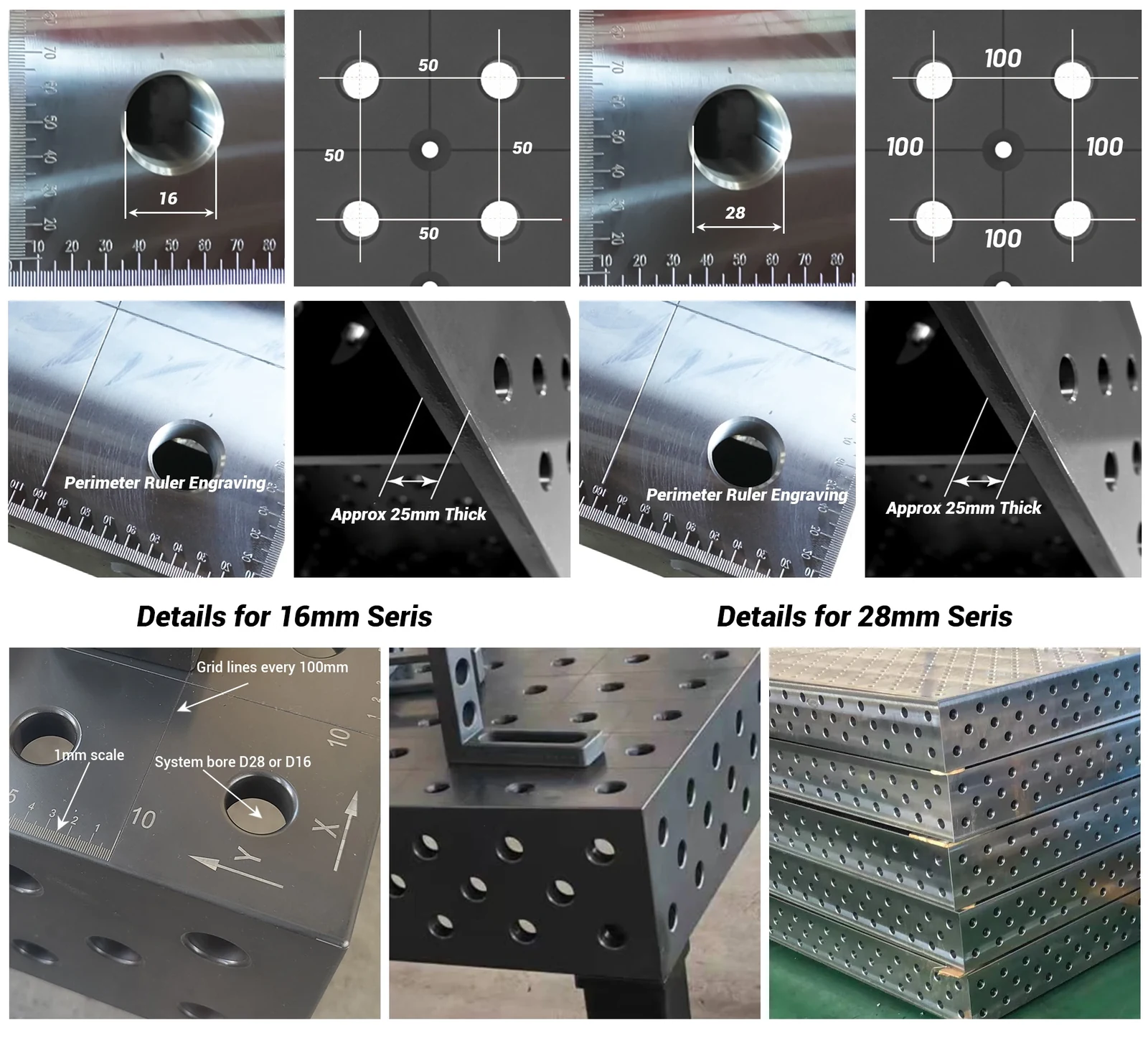
What actually changes between the series
The hole diameter sets the size of the pins, bolts and clamps the table can accept. A larger hole takes a larger pin, and a larger pin resists more sideways force. That is the whole trade: bigger holes hold heavier work, smaller holes let you place stops closer together.
Two other things move with the series. The hole grid spacing sets how precisely you can position a stop, and the thickness of the table plate sets how much the surface resists deflection under load. These are chosen at the same time as the hole system, which is why it is a configuration decision rather than a single part number.
| Series | Hole diameter | Typical use | What it gives you |
|---|---|---|---|
| D16 | 16 mm | Small to medium parts, jigs, sub-assemblies | A fine grid, so stops and clamps can sit close to small geometry |
| D22 | 22 mm | General fabrication with mixed job sizes | A middle option that covers several product sizes on one table |
| D28 | 28 mm | Large frames, thick plate, heavy welded structures | Larger clamps and pins, so more resistance to movement under load |
Start from three numbers
You can narrow the choice before looking at any catalogue by writing down three figures from the job.
- The smallest and largest workpiece footprint that will go on the table. This decides the grid fineness you need.
- The heaviest single part, including any fixture or support structure attached to it. This decides the pin and clamp size.
- The tightest position tolerance on the assembly. This decides whether a fine grid is needed at all.
Where the choice usually goes wrong
The common mistake is ordering a large-hole table for small parts because it looks more robust. The table will hold the part perfectly well, but the coarse grid limits how close two stops can be, so small assemblies become harder to set up than they need to be. The part is also surrounded by clamps that are far heavier than the job needs.
The opposite mistake is using a fine-grid table for heavy welded structures. The table itself is rigid, but the smaller pins and clamps are the limiting item, and they can shift under the load of a large frame. In that case the table is not the weak point — the tooling on it is.
What is available on our tables
Our fabricated steel and nitrided steel 3D platforms are built with a 16, 22 or 28 mm hole system. Hole spacing is 100, 125 or 150 mm, and holes can be supplied as a plain bore, a metric M16 to M24 thread, or an imperial thread. Tables are made from 500 x 500 mm up to 4000 x 2000 mm with plate thickness of 100, 150, 200 or 250 mm, so the grid and the plate can be matched to the job rather than chosen from a fixed list.
- Hole diameters: 16, 22, 28 or 36 mm
- Hole spacing: 100, 125 or 150 mm
- Plate thickness: 100, 150, 200 or 250 mm
- Working faces: machined top plus four machined side faces
A quick way to decide
- Workpiece fits in one hand to arm length, tolerance is tight: D16.
- Workpiece size varies between jobs, one table has to serve all of them: D22.
- Workpiece is large, heavy, or welded from thick sections: D28.
- Still undecided: send the three numbers above and we will recommend a series with the reason, so you can check the logic yourself.