
Where the first kit stops being enough
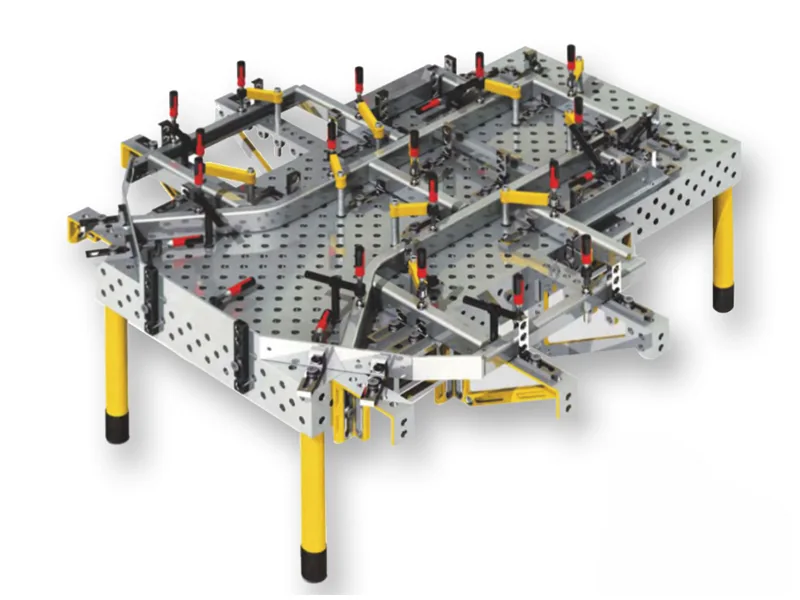
Every table starts the same way: a platform alone cannot hold a part, so accessories are required from day one, and the first order is usually a kit chosen for the work you had at the time. That is a sound decision — it covers a working set of operations in one dispatch instead of five.
The kit does not fail later. It simply covers a different set of operations from the ones that arrived with the new work: a family of similar frames, a repair job with an awkward overhang, a product whose datum sits somewhere the original stops cannot reach.
The signs are physical rather than commercial. You are stacking parallels and shimming to reach a height. Someone has to hold the part while the second clamp is tightened. Setup takes longer than the welding that follows. Those are the moments the second purchase becomes worth planning.
Reading your own work: which operations repeat
Kits and single items are added once the repeating operations are known. That one rule argues for a month of notes rather than another round of shopping: the tooling that earns its place is the tooling that gets used weekly.
A simple log does it. For each setup, write down what the operation was — locating from a machined face, holding a tube at height, squaring a frame, supporting an overhang — and how long it took. After a few weeks, the pattern is obvious: three or four operations account for most of the time, and a long tail of one-offs accounts for the rest.
The range helps here. The accessory range runs to 188 SKUs, grouped into clamping, locating, connecting, support and maintenance families. Reading it by family rather than by part number is what turns “we need more clamps” into a specific request.
Buying single components to close a specific gap
Once the blocked operation is named, one element usually closes it. Work that sits too high for the clamp reach belongs to the support family. A datum that drifts between parts belongs to locating. A joint that flexes when the clamp is tightened belongs to connecting — the part needs to be held, not pressed.
The discipline is in the description. Name the operation, name the family, state the hole system. Anything vaguer tends to come back as the wrong part, and a wrong part costs a week, not a line item.
Buying singles is also the honest answer when the first kit is still doing its job: you avoid paying twice for elements already in the cabinet. The trade-off is administrative — several dispatches, and a real risk of inconsistent fit if the hole system is not stated on every line.
Matching the hole system before anything else
Mixing hole systems between a table and accessories means they will not fit. That is true for kits and for singles, and it is the first thing to confirm: hole diameter, and whether the threads are metric or imperial.
Kits are matched to the table hole system before dispatch, which is why the question comes up at ordering rather than on arrival — the matching happens at the factory. It also means a kit bought for one table should be described against that table, not against the workshop in general.
If a second table is planned, decide the hole system once. Two tables on different systems split the tooling into two pools that cannot borrow from each other, and operators lose the habit of sharing.
Building a second station from what already works
When the problem is throughput rather than capability, the second station is a copy rather than an experiment. The tooling that already works on the first table is the specification for the second: the same locating elements, the same clamping positions, the same setup sequence.
That is where a kit earns its place a second time. A complete set for the new station arrives matched and consistent, so both tables run the same setup and an operator can move between them without relearning. Adding one or two unfamiliar elements on top is fine — as long as they are additions, not replacements for a system that already works.
A practical order for the second purchase: list the repeating operations, mark which of them will repeat at the new station, duplicate those elements, and only then spend on the operations you have not yet solved. It is a shorter list than it feels, and it is the one that gets used.