
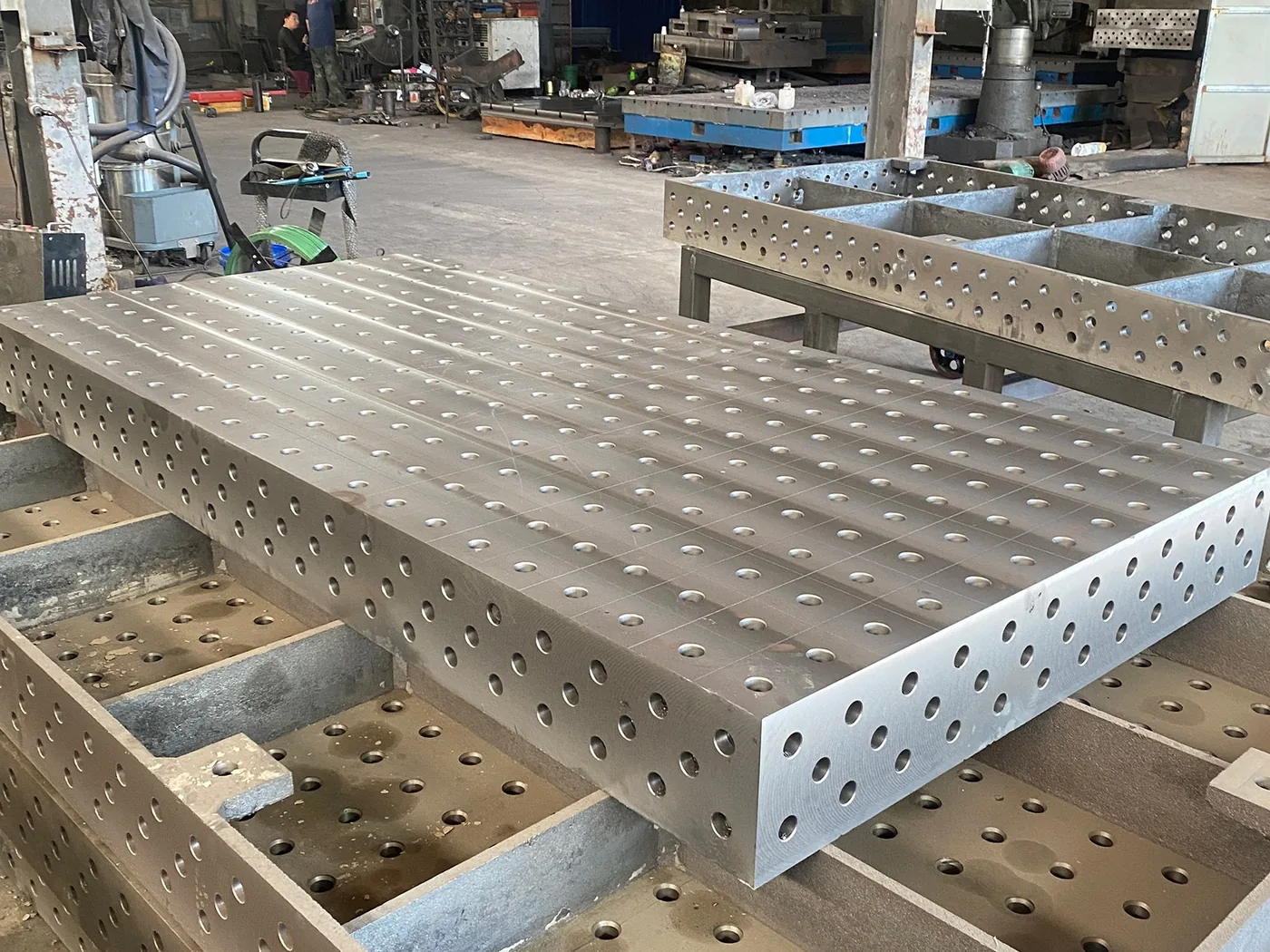
Two constructions, one comparison view
| Aspect | Fabricated steel (BECO standard) | Cast iron (on request) |
|---|---|---|
| Construction | Welded plate body, Q235 or Q355, with internal reinforcement | HT250 or HT300 casting, or other materials on request |
| Working faces | Top and four side faces machined with the hole grid | Confirm grid layout and faces with the supplier |
| Size range | 500 x 500 mm up to 4000 x 2000 mm | Confirm pattern sizes with the supplier |
| Platform height | 100 or 200 mm; custom heights available | Confirm with the supplier |
| Availability | Built to the confirmed configuration | Available on request; confirmed at quotation |
What fabricated steel allows
A fabricated body is welded from plate, so the size is not bound to a pattern. Large-format platforms up to 4000 x 2000 mm are practical precisely because the body is built rather than cast — a casting of that footprint would need a pattern made for the job, which is why very large tables with a five-face grid are typically fabricated.
The welded construction also places material where the load is: internal reinforcement carries the machined working faces, and rib layouts follow the table size and the clamping loads it will see. After welding, the body is stress-relieved before final machining, so the geometry machined into it holds.
Where cast iron fits, and what to ask
HT250 and HT300 cast iron is available on request, and other materials beyond the standard list can also be discussed. Because casting and fabrication are different processes, the honest way to compare a specific cast option against a fabricated one is to put both quotations side by side against your requirements: the grid layout you need, the faces that must be machined, the size, and the finish.
The questions worth asking any supplier of a cast table are the ones the quotation should answer: which faces carry the grid, what flatness grade is held, how the table is supported, and what happens if a table in the batch has to match the others.
The decision inputs
None of these inputs alone decides the material. They decide it together, which is why the material is written into the quotation alongside the hole system and grade rather than assumed at the start.
- The workpiece: size, weight and how it must be accessed while clamped.
- The grid: hole system, spacing and which faces must carry it.
- The size: larger footprints with five-face grids point toward fabrication.
- The specification: flatness grade, surface treatment and platform height.
Confirming material on the quotation
Whatever the construction, the confirmation step is the same: the quotation states the material, the construction, the hole system, the flatness grade and the treatment, and the drawing is confirmed before production starts. Send the workpiece details and the material recommendation comes back with the reasoning, so it can be checked against your requirements before anything is cut.