
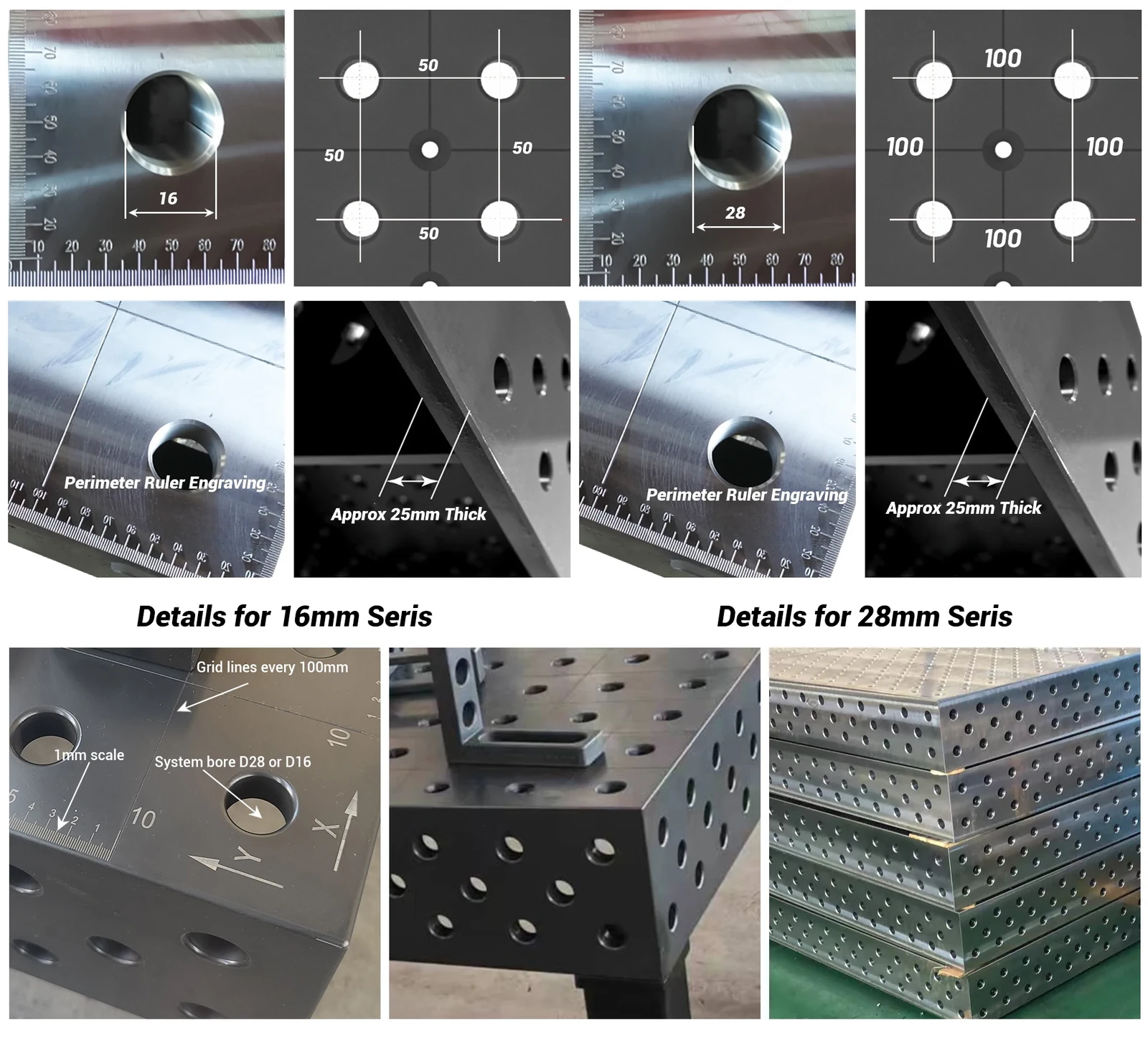
Diameter and spacing are two different decisions
The hole diameter — D16, D22, D28 or D36 — decides which pins, clamps and stops physically fit. The spacing decides how close together those mounting points can sit. Both are set at machining, along with the flatness specification, and both have to be stated on the enquiry because they change the machining route.
A useful way to keep the two apart: diameter is about the strength and size of the tooling; spacing is about how finely you can position it around the workpiece.
What a 50 mm grid changes
- Stops and clamps can sit closer to small geometry, where a 100 mm pitch would place the nearest hole too far from the part.
- Datum points can be set tighter together for compact fixtures and sub-assemblies.
- More holes per square metre of surface, so a mounting point is almost always where the sketch wants one.
- The trade-off is more open surface per hole and a denser pattern to keep clear of spatter during welding.
What a 100 mm grid changes
A 100 mm pitch is the general-fabrication grid. It leaves wider stretches of plain surface between holes, which some operators prefer for larger parts, and it matches the common pitch of standard tooling across the range.
For frames, bases and structures where the clamping points sit tens of millimetres apart rather than a few, the 100 mm grid gives up nothing in practice — the geometry of a large part rarely needs two mounting points 60 mm apart.
Matching the spacing to the work
The sketch test settles it quickly: draw the smallest recurring part at true scale, mark where its clamps and stops must sit, and check whether those marks can all land on a 100 mm grid. If they can, 100 mm is enough; if two marks fall between holes, that job wants a 50 mm grid.
| Work | Spacing that usually fits | Why |
|---|---|---|
| Small precise parts and jigs | 50 mm | Tooling sits close to the geometry, datum options stay dense |
| Mixed fabrication, one table, many jobs | 50 or 100 mm | Depends on the smallest recurring parts in the mix |
| Frames, bases, large structures | 100 mm | Clamping points sit far apart; open surface helps |
Confirming spacing on the enquiry
State the spacing together with the hole diameter, the table size and the flatness grade — the combination sets the machining route. If the workpiece description is easier to send than a specification, send that instead and the recommendation will come back with the reasoning for both diameter and spacing.