
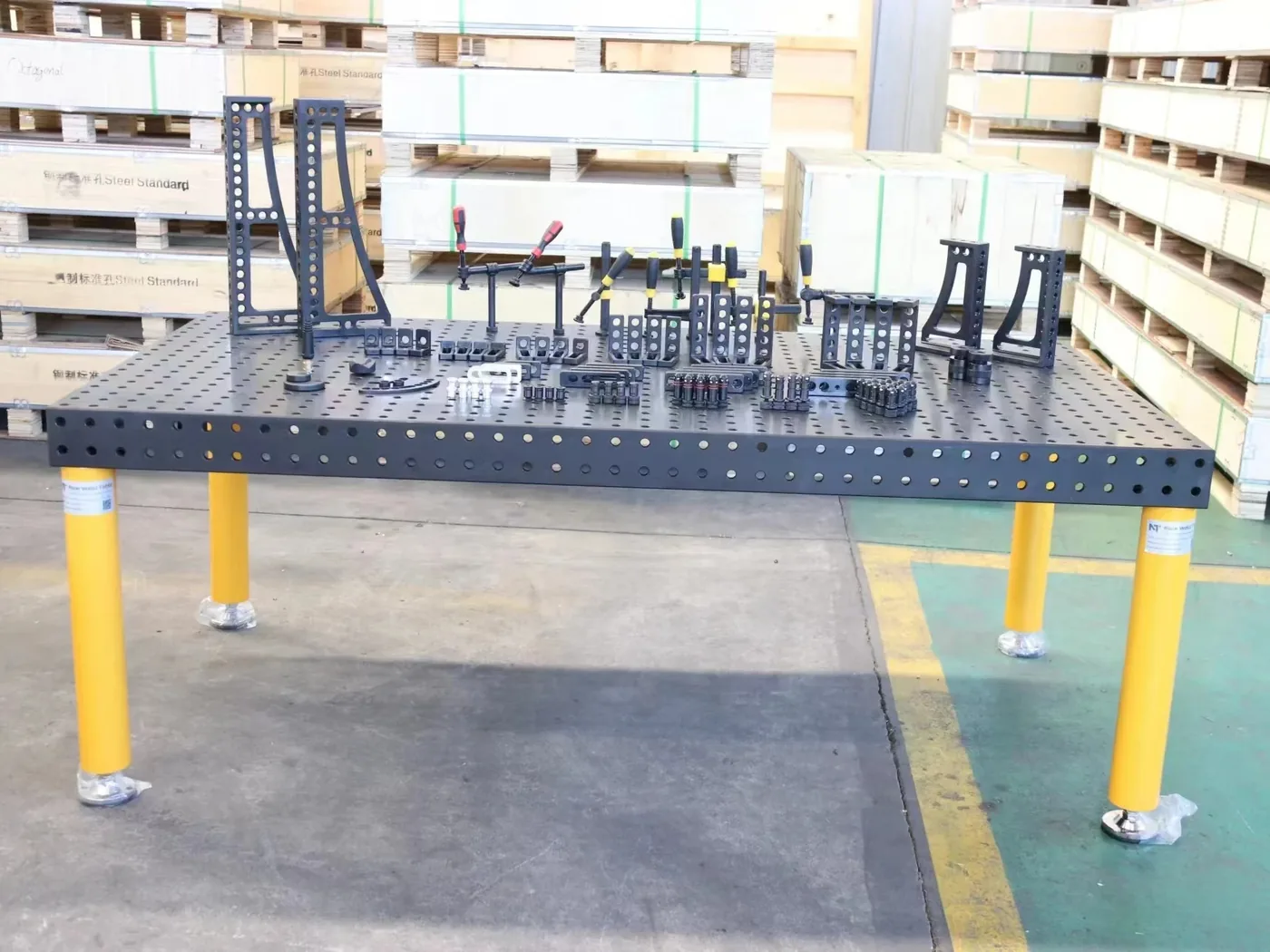
Why round work is different
A rectangular frame sits still on a flat surface; a pipe rolls. That single difference reshapes the whole setup: before any clamping force goes on, the axis of the part has to be located — the line the weld needs to follow — because clamping a rolling part against the wrong axis moves the seam exactly when the torch arrives.
So the setup order flips. On flat work you often clamp first and adjust; on pipe you support first, locate the axis with stops and squares, check it, and only then clamp. The table grid helps because every support and stop mounts at a known position.
The supporting cast
| Element | Role on round work |
|---|---|
| Support blocks | Carry the pipe at set heights; pairs create a cradle from two contact points |
| U-shaped square boxes | Hold round stock in a stable cradle with the grid available on their faces |
| Locating stops | Set the axial position so the seam lands where the drawing says |
| Angle squares | Square the axis to the table edge for assemblies with branches |
| Side faces | Vertical reference for tall or long assemblies on a five-face platform |
Using the side faces
Long pipe assemblies outrun the tabletop quickly. On a five-face platform the side faces carry the same hole grid, so brackets and stops mount vertically and a long assembly can be referenced along the table edge while the top stays open for the torch. This is the same argument as for tall parts generally: the side face is a datum you do not have to build from blocks.
When a dedicated cradle earns its place
Loose blocks suit a pipe run that changes every job. When the same round part runs weekly — a drum, a vessel section, a recurring pipe diameter — a fabricated cradle with a semi-circular cutout holds the radius exactly and never needs re-shimming. BECO builds such cradles as custom weldments: formed plate fitted to rolled sections, stress relieved, with the cradle radius holding its shape through welding.
The honest test is repetition. If the setup is re-sketched every time, blocks are faster. If the setup is rebuilt identically every shift, the cradle pays for itself in the first month.
A worked setup sequence
- Place support blocks or U-shaped boxes on the grid at the part length positions.
- Rest the pipe; locate the axial position with stops against a datum edge.
- Square the axis to the table with angle squares, or reference a side face.
- Check the seam position against the drawing before full clamping.
- Clamp lightly, tack, re-check, then complete the weld sequence.
What to send when enquiring
The pipe diameters and wall thicknesses, the length ranges, and whether the same parts repeat. That is enough to recommend the hole system — D22 for mixed work, D28 for heavy pipe and thick-wall vessels — and to say whether blocks and boxes cover it or a fabricated cradle is worth quoting.