
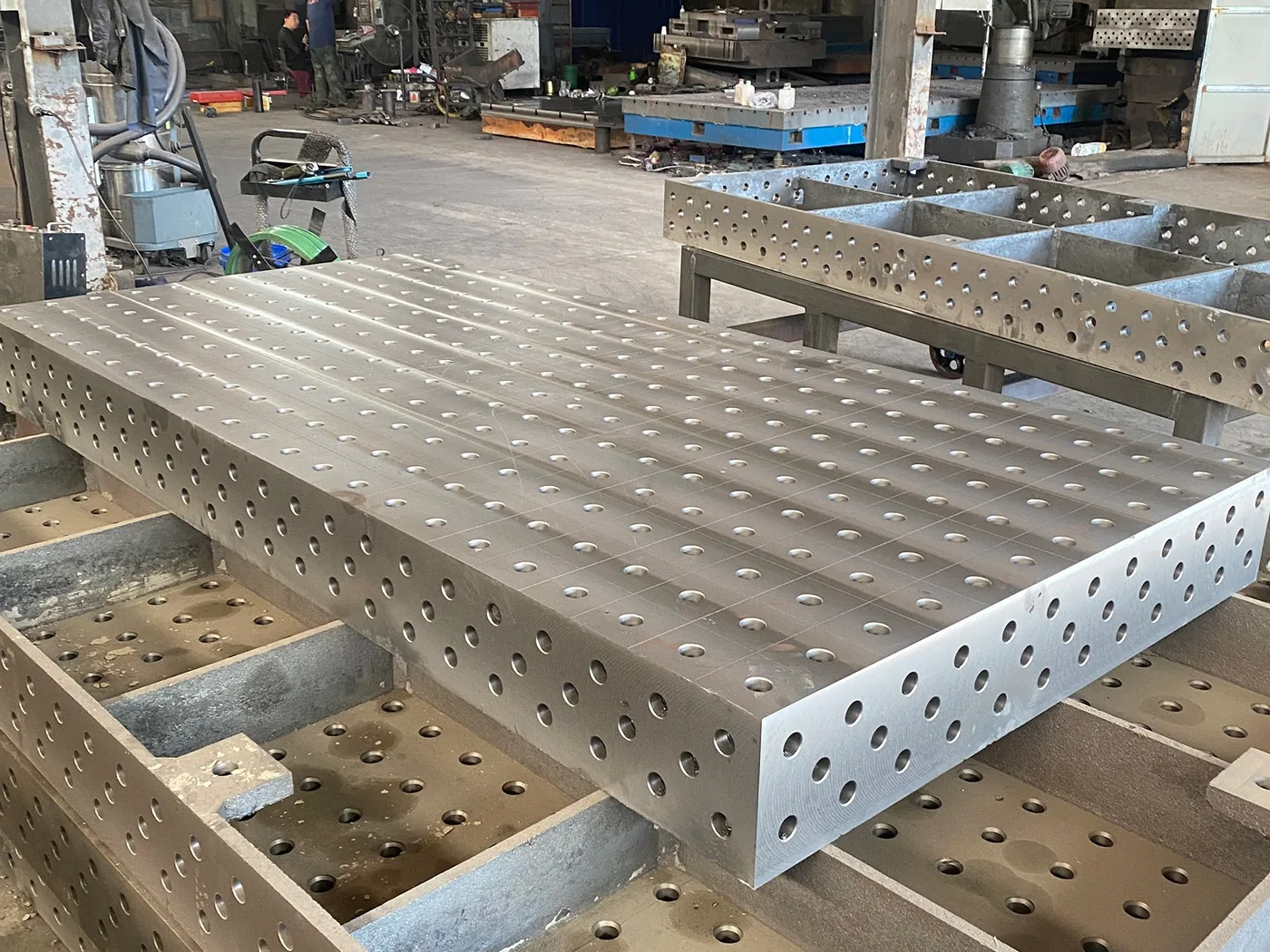
The difference is where the hole grid stops
A tabletop-only design presents a single machined plane. Stops, clamps and supports sit on that plane, the part is positioned within it and everything is forced down onto the top surface. That covers a large share of fabrication work, because many jobs are flat and are clamped entirely from above.
A 3D platform machines the top and the four side faces, and the hole grid is carried onto those vertical faces as well. The working surfaces are therefore at right angles to each other, and tooling can be mounted on any of them. On BECO tables the working faces are the top and four side faces, and the same D16, D22 or D28 hole system runs across them.
The practical consequence is that clamping is no longer limited to pushing a part downwards. A clamp or angle bracket bolted to a side face pushes the part horizontally against a vertical reference, which is what you need when height or squareness has to be controlled, not just flatness on the table.
What the side faces actually let you do
- Clamp at 90° to the tabletop, so a part can be pushed against a vertical datum instead of only held down on the top.
- Square tall or boxed assemblies directly against a side face, without building a tower of blocks on the tabletop to create a vertical reference.
- Reach the side of a workpiece that is too tall to clamp effectively from above.
- Mount stops and supports that project beyond the table edge, which helps when a frame overhangs the platform.
- Keep a second datum available when the top face is already crowded with clamps and tooling.
When a top-face table is enough
The extra faces are produced by machining, so they add work to the table. If a job is flat, lightly clamped and always approached from above, the vertical faces do not contribute to that job and a simpler surface would do the same work.
That calculation changes when the table has to earn its place over several years. A modular five-face platform is reconfigured with tooling rather than rebuilt with dedicated jigs, so the faces keep their value the first time a taller part, a boxed frame or a side-access weld arrives. The question is not whether the current job needs the side faces, but whether anything else will be run on the same table.
A short decision list
| Question | If yes | If no |
|---|---|---|
| Do you clamp or reference anything at 90° to the tabletop? | Side faces earn their place. | A top-face grid may be sufficient. |
| Are parts tall or box-like, needing a vertical datum? | A side face provides that datum directly. | Top-face positioning is enough. |
| Do you build frames or boxes where the sides must stay accessible? | Choose a five-face 3D platform. | A flat top surface covers it. |
| Will the table run only one flat, light job for its whole life? | A simpler table is defensible. | A modular 3D table stays flexible. |
What to confirm on a quotation
This is the part that separates a genuine 3D table from a description that only sounds like one. Ask which faces are machined and carry the grid, and whether the side grid uses the same hole system as the top. A platform whose side holes do not match the top holes will not accept the same clamps and pins on both, which defeats the purpose.
- Which faces are machined and drilled: the top only, or the top and the four sides.
- Whether the same D16, D22 or D28 system is used on every working face, so tooling fits on all of them.
- Platform body height, available in 100 or 200 mm with custom heights on request.
- Hole spacing of 50 or 100 mm, and the hole type for the accessories you intend to use.
- Flatness grade, chosen from the assembly tolerance rather than the tightest figure available.
- Materials, typically Q235, Q355, HT250 or HT300, with other materials available on request.
- Support arrangement, since legs or a frame with levelling feet or castors affects how the surfaces sit in use.
Decide the faces before the hole system
Sequence matters. First decide the working faces, because that sets the platform construction. Then choose the hole system from the workpiece and the clamping load, then the table size from the envelope and clamp clearance. Choosing a hole system first often leads to a table that is the right scale but the wrong construction, and correcting that after the fact means a new platform rather than a new accessory.