
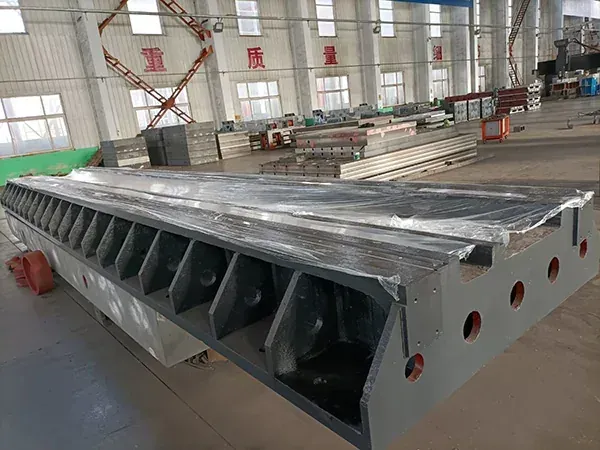
Platform height is one link in a chain
A common way to read the specification is top-down: the working height is where the operator needs the weld, so everything under it adjusts. On a modular table that stack runs floor, support, platform body, fixture, part — and the platform body is the layer in the middle.
That position gives the body height two roles at once. It contributes to the finished working height, and it is the structure that carries the reinforcement and the machined faces. Choosing 100 or 200 mm touches both roles, which is why it belongs on the quotation rather than on the installation checklist.
The two standard heights
| Body height | What it changes |
|---|---|
| 100 mm | Lower stack on the same support; less space for deep reinforcement inside the body |
| 200 mm | Taller stack on the same support; more room for internal reinforcement and lift provision |
| Custom | Available on request when the standard heights do not meet the working-height calculation |
Reading the chain: support, body, fixture, part
The finished working height runs from the floor up: the support (legs or a fabricated frame with levelling feet or castors), then the platform body, then the fixture stack, then the part. The same 200 mm body stands at different heights on different supports, and the operator elbow-height calculation from the size guide works on the finished stack, not on the body alone.
This is also why support and body height are best decided together. Choosing a deep body and then discovering the finished height sits above comfortable elbow range means revisiting one of the two — an easier conversation before production than after.
Where the deeper body helps, and where it costs reach
A deeper body carries more internal reinforcement, and reinforcement is what carries the machined faces and resists the loads of heavy clamping. Buyers running thick plate, large frames or heavy fixturing usually lean toward the 200 mm body for that headroom.
The cost is in the chain: the same support under a 200 mm body raises the working surface by 100 mm compared with the 100 mm body. For seated work, small parts or operators who work close to the table edge, that difference is felt. The honest method is the elbow-height calculation with the real fixture stack, then choosing the body that lands the working feature in range.
Custom heights, and when to ask
- Custom heights are available on request when neither standard body lands the stack in range.
- Typical triggers: a fixed interface height to a positioner or production line, seated workstations, or a support design that is already fixed.
- Custom affects the body, not the grid — the hole system, spacing and flatness grades are confirmed the same way as on standard heights.
Deciding it together with the support
The support and the body height shape each other, so they are confirmed on the same quotation drawing: which support type, which body height, and the finished working height they produce together. State the workpiece and the operator position with the enquiry, and the recommendation covers the stack with the reasoning — rather than leaving two linked decisions to be discovered at installation.