
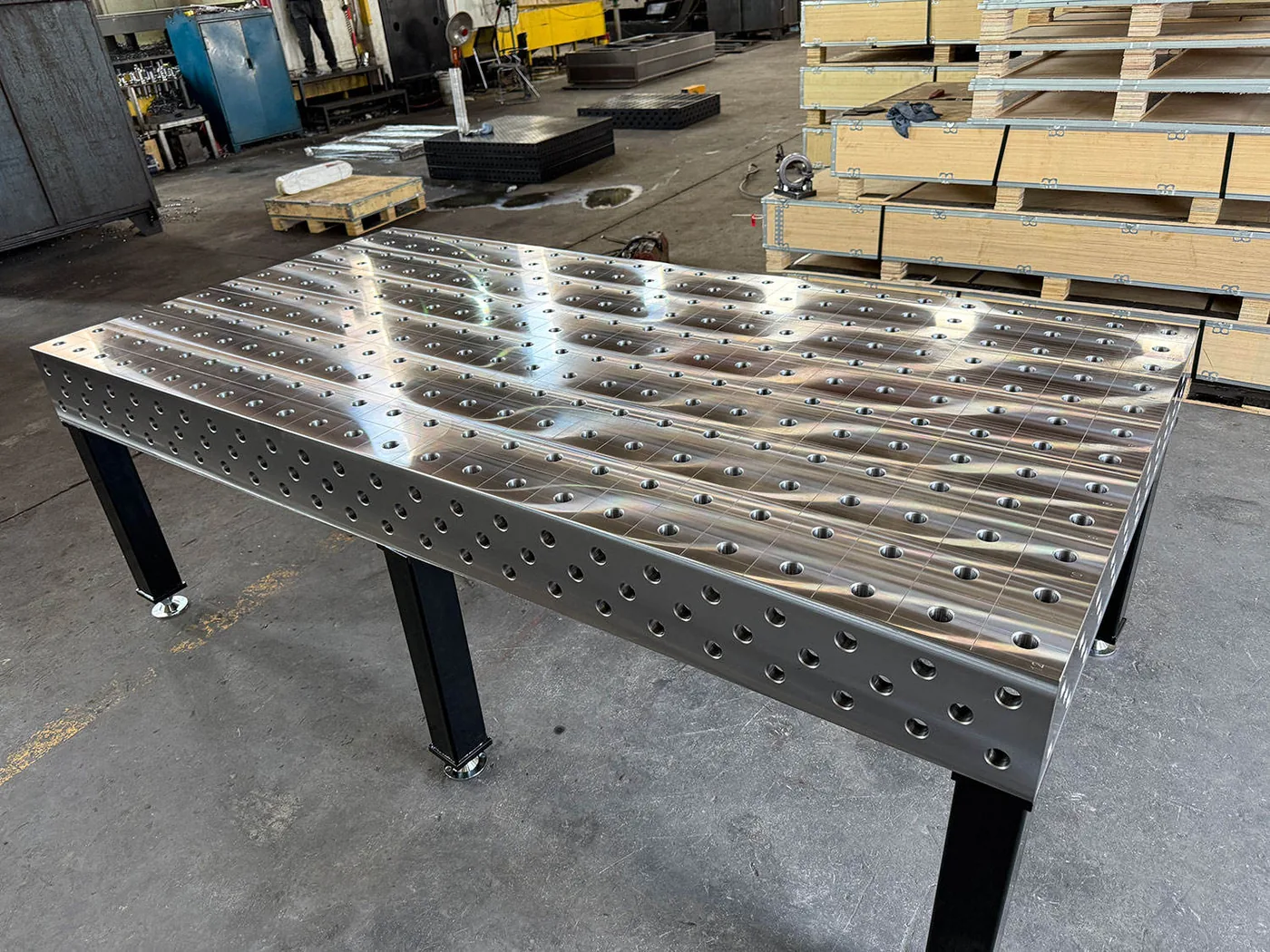
The two support modes
| Aspect | Castors (mobile) | Levelling feet (fixed) |
|---|---|---|
| Position | Table moves between bays or aside for access | Table stays where it is installed |
| Stability under load | Lower; the base is designed to roll | Higher; the load goes straight into the floor |
| Flatness behaviour | Surface must be re-levelled after each move | Brought into level once, then held |
| Height adjustment | Via the caster stack | Levelling feet set the height precisely |
| Suits | Shared stations, demo tables, changing layouts | Production stations, robot cells, precision work |
When castors make sense
Some tables live mobile lives: a training bay that reconfigures weekly, a table that parks aside for forklift access, a demonstration unit that visits customers. Castors serve that life well — and BECO supplies them as a standard support option, so the mobility is built in rather than improvised with a trolley underneath.
The trade to understand is that a rolling base is designed to roll. Under heavy clamping loads, a castor-mounted table has more give than a fixed one, and the surface must be re-levelled after each move if the work cares about the grade.
When fixed and levelled wins
The fixed condition is the reference for everything else. A table on levelling feet is brought into level once after positioning, and that is the state its flatness grade describes. Production stations, fixtures that hold tolerance across batches, robot cells and any table used as a measuring reference all belong on feet.
Levelling feet also do a second job: they set the finished working height precisely, alongside the platform height and the support frame. If operators of different heights share the station, or the table must meet a positioner at a specific interface height, feet are how the last centimetres are tuned.
The height chain
Finished working height is a stack: floor, support (feet, castors or frame), platform body — 100 or 200 mm, with custom heights available — then the fixture and the part. Every element in the chain moves the working feature. This is why the support choice is confirmed on the quotation drawing rather than improvised at installation: the same platform stands at different heights on different bases.
Confirming support on the drawing
The support arrangement is a specification item like the hole system: state castors or levelling feet, and the frame is built around that choice. If the station might move later, say so — the conversation is easier before fabrication than after.