Where support sits among the five accessory families
The accessory range for a 3D welding table is organised into five families: clamping, locating, connecting, support and maintenance, together 188 SKUs. Each family owns one job. Locating elements set the datums. Clamps hold what locating has set. Connectors tie the elements to the grid. Maintenance items keep the system serviceable.
Support comes before all of that in the setup order, because a part has to rest steadily before its position can be set or held. The support family - support blocks and U-shaped square boxes - exists for the work that does not sit flat on the grid by itself: round stock, raised sections, frames on legs, parts with a boss or a flange in the way.
Support blocks: lifting work off the surface
Support blocks raise the work above the table surface. That does two things. First, it creates clearance under the part, so a weld seam, a protruding bolt or a clamp path can run underneath without fouling the table. Second, it puts the part at a working height where its datum edges line up with stops and squares mounted in the grid.
Because the blocks mount into the same hole system as every other element, their positions are repeatable from one setup to the next. Placing them under the stiff members of the part - rather than wherever there happens to be a hole - keeps the weight on the supports instead of hanging between them, and keeps a flexible part from rocking while it is measured.
U-shaped square boxes: holding round and raised work
A U-shaped square box is the answer for round stock on a flat grid. The part sits in the opening of the U, so the round section is cradled from below and both sides rather than balancing on the curve of its surface. The same shape holds raised work: a leg, a boss or a flanged section that needs the area under it left open.
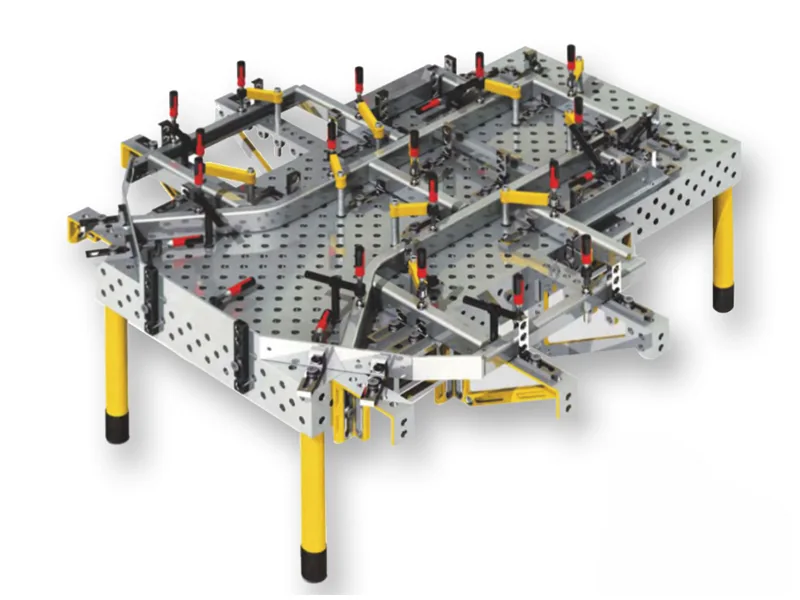
In practice the U-boxes and the support blocks get combined on one setup: blocks set the height of a frame, a U-box carries the round member that runs across it, and the locating elements then reference against both. That combination is what makes pipe and vessel work possible on a table - adaptable locating elements support the curved parts and pipe assemblies, and the U-boxes keep them from rolling while the tack welds go in.
When a repeating part justifies a dedicated cradle
Standard support elements are adjustable and reusable across many parts. A dedicated cradle is the opposite trade: built once for one part, but faster and more exact every time that part comes back. The examples page shows a fabricated cradle with a semi-circular cutout - a support built for a repeating round part, so the part drops into the cutout at the same position every cycle without measuring.
The threshold is repetition. A round part welded once is fine in a U-box. The same part welded weekly is worth a cradle, because the setup time saved on every repetition pays for the fabrication. The cradle itself mounts into the grid like any other element, so it stays usable if the table moves or the layout changes.
Choosing support alongside locating and clamping
Support is chosen from the shape of the work, not from the table. Round and raised sections point to U-shaped square boxes. Parts that need clearance under them point to support blocks. Curved parts and pipe assemblies point to adaptable locating elements used as supports. Everything else in the kit - clamps, stops, squares - is sized around what the support family has made stable.
Support can also be added after the first kit without rethinking the order. The five families share the same hole system, so blocks and U-boxes slot into an existing setup wherever a new part shape demands them. If the work includes round members, it is worth listing them in the enquiry alongside the part sizes, so the support elements arrive with the table instead of after it.