
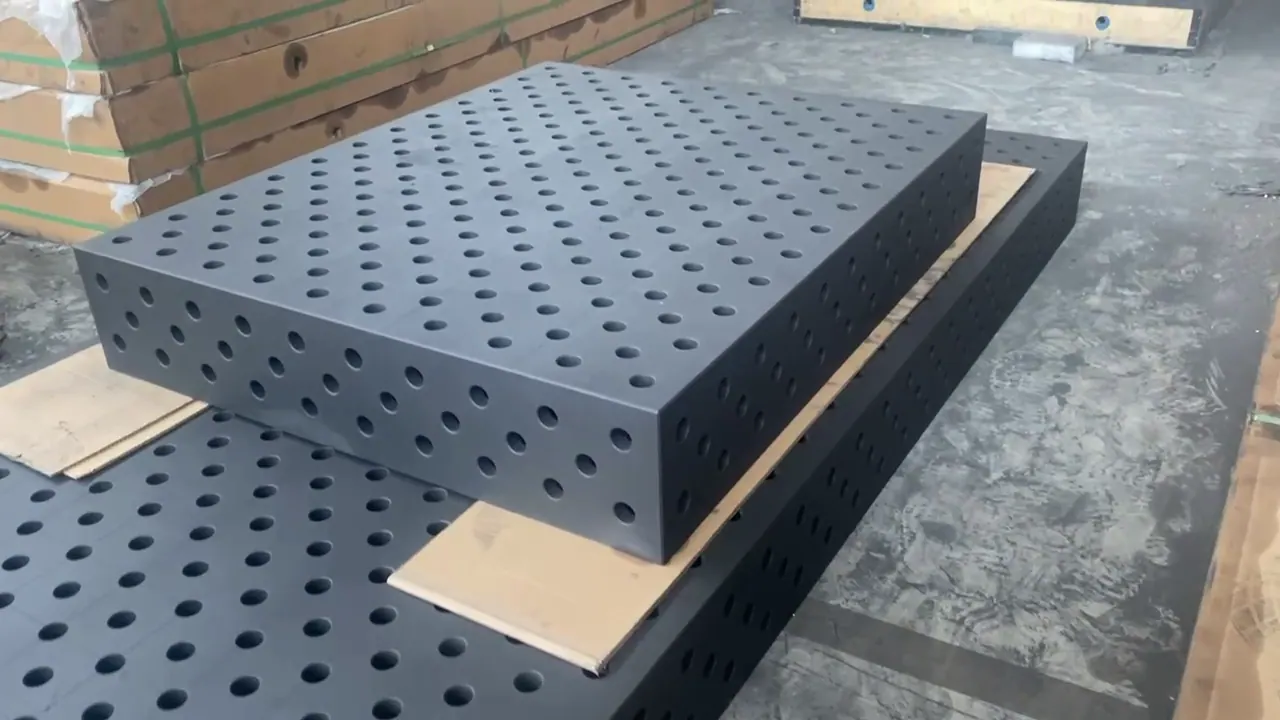
What packing has to survive
A welding table is heavy, hard and — this is the part packing must respect — finished. The top face and the side faces are machined surfaces, and the hole grid is the interface every clamp and pin will use. Handling between the workshop and the destination floor involves lifts, set-downs and shifts where a bare corner or an un protected face could take damage that no discount undoes.
So packing is not an afterthought at the end of production. It is the last step that protects everything the previous steps produced.
The sequence before the crate closes
The order matters. Protection goes on after verification, so the faces that get wrapped are the faces that were just measured. And the lift uses the designed lifting points — lifting lugs and the base structure — rather than improvising on the finished surface.
| Step | What happens |
|---|---|
| Verify | Dimensions, hole layout and the agreed flatness grade are checked against the drawing |
| Protect | Working faces are protected so nothing contacts the machined surfaces in transit |
| Lift | The platform is lifted onto its transport base at the designed points |
| Crate | The table is crated for export, ready for the shipping leg |
What buyers should ask about packing
None of these questions are difficult for a supplier that packs regularly, and the answers tell you how the table will actually arrive — before it does.
- How are the machined faces protected in transit, and what do they arrive covered with?
- Where are the lifting points, and what lifting capacity must the unloading side provide?
- How is the crate oriented and moved — forklift, crane or both?
- Do accessories ship in the same crate as the table, or separately?
- What documentation travels with the shipment?
Planning the unloading at your end
The receiving side matters as much as the sending side. Before the shipment date, confirm what will lift the table off the transport — a crane, a forklift with adequate capacity, or both — and that the path from unloading point to final position is clear. Levelling feet or castors are fitted as specified, and the table is brought into level once it stands where it will live.
The arrival check then follows the receiving-inspection sequence: paperwork, dimensions, a test pin in the datum holes, accessories against the kit list.
Lead time and staged batches
Delivery is typically around 10 days from confirmation, per configuration. Multi-table orders are staged against the schedule agreed at quotation, so a production line can absorb the tables as its installation plan progresses rather than taking a whole fleet at once.