
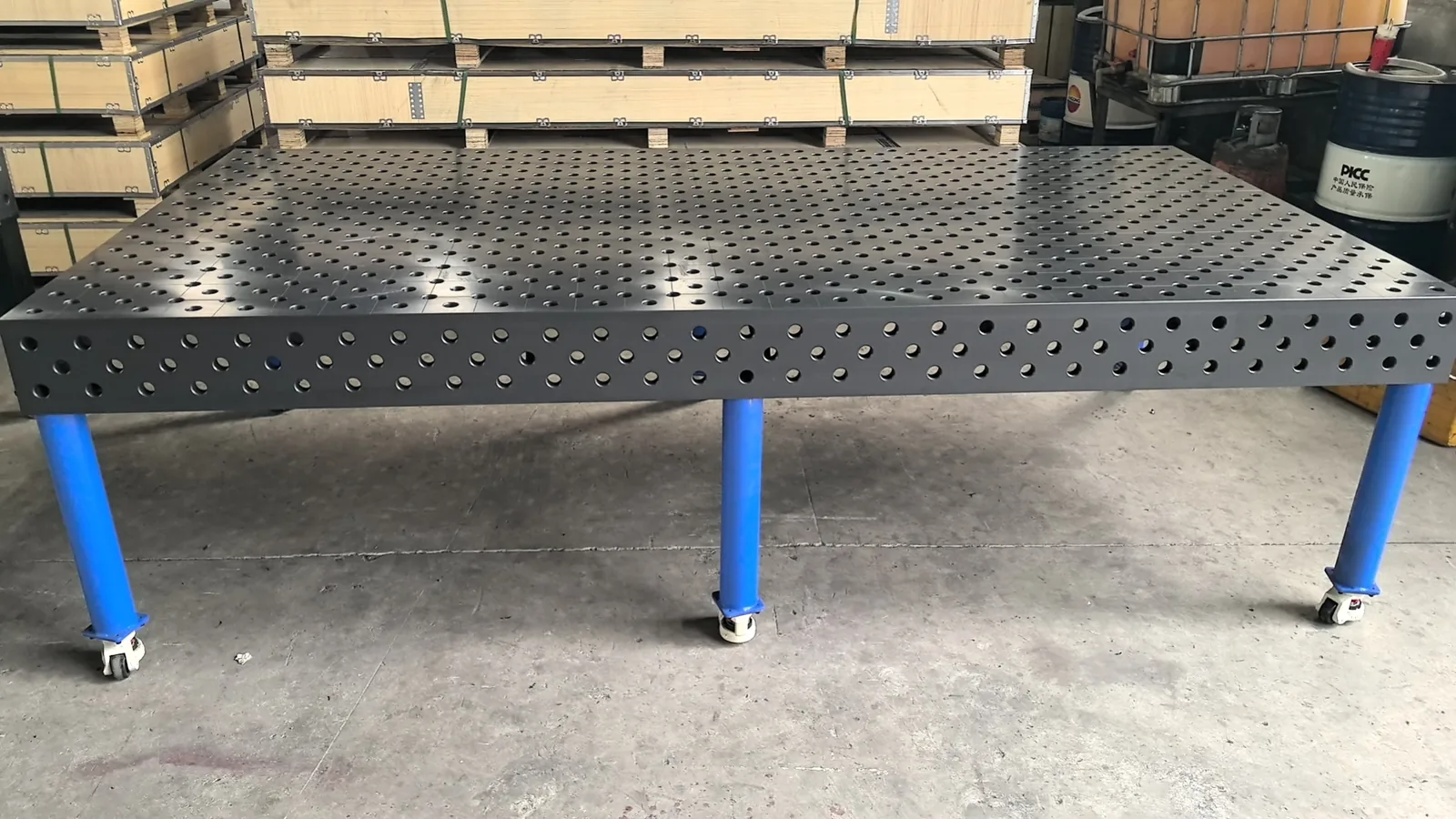
The three options side by side
| Treatment | What it is | Where it helps | Upkeep |
|---|---|---|---|
| Rust-preventive oil | Protective oil film on the machined faces | Baseline corrosion protection for any table | Reapply when idle; clean in use |
| Black oxide | Conversion treatment giving a dark finish | Slows surface corrosion; darker, low-glare surface | Normal care; oil when idle |
| Plasma nitriding | Nitrogen diffused into the surface, HV450-630 | Wear resistance at the hole grid and faces under daily use | Normal care; oil when idle |
Choosing by duty cycle
The table that welds occasionally and sits the rest of the time does not need a hardened surface — its enemies are idle-time rust and ordinary handling, which oil and normal care cover. The production table is a different case: clamps and pins go in and out every shift, and that repeated contact is what wears a soft hole grid first.
Black oxide and nitriding both change the surface rather than adding a layer. Nitriding diffuses nitrogen into the steel to a hardness of HV450 to HV630, which is what gives the grid its resistance to daily insertion wear; black oxide is the lighter option that slows corrosion and leaves a dark, low-glare finish.
Why nitriding happens after machining
Every treatment in the range is applied after the hole grid and working faces are machined. Nitriding in particular diffuses into the surface rather than building one up, so the machined geometry — hole diameters, spacing, flatness — is retained through treatment. You are not choosing between a machined surface and a treated one; the surface is machined first, then treated.
That sequencing is worth verifying with any supplier, because a treatment applied before final machining, or a coating thick enough to shift dimensions, would change what arrives.
What the finish does not change
- The hole system: D16, D22, D28 or D36 stays as specified.
- The flatness grade: machined before treatment and retained through it.
- The accessory range: the same clamps, pins and stops fit whatever the finish.
- The basic routine: cleaning in use and oil when idle still applies to every table.
Confirming the finish on the quotation
The treatment is written into the quotation beside the hole system and flatness grade. If the duty cycle is not clear-cut, describe how often the table will run and what it welds — the recommendation comes back with the reasoning, so the finish is a checked decision rather than a default.