
What changed on 1 January 2026, and what did not
CBAM has been law since 2023 — Regulation (EU) 2023/956 — but for two years it was a reporting exercise. The transitional period ran from October 2023 to the end of 2025: quarterly reports, no payment. On 1 January 2026 the definitive regime began, and the mechanism became a financial instrument for six sectors: iron and steel, aluminium, cement, fertilisers, electricity and hydrogen.
The regime was softened on the way in by Regulation (EU) 2025/2083, the so-called Omnibus amendment, and three of its changes matter to anyone buying steel from outside the EU. A single mass-based exemption was introduced at 50 tonnes of imported CBAM goods per importer per year. Certificate sales were deferred, so nothing is bought during 2026. And the annual declaration deadline moved from 31 May to 30 September.
So the 2026 picture is: no invoice yet, real obligations accumulating. The chargeable share of embedded emissions — the slice no longer covered by free allocation — is 2.5 per cent in 2026, 5 per cent in 2027, and climbs to 100 per cent by 2034. Certificate prices track the average EU ETS auction price, published quarterly this year at roughly 75 euros per tonne of CO2e and moving to a weekly basis from 2027. The sums are small now. The direction is one-way, and the deadline that matters is 30 September 2027, when 2026 imports are declared and surrendered.
Is a welding table a CBAM good? The code decides, not the name
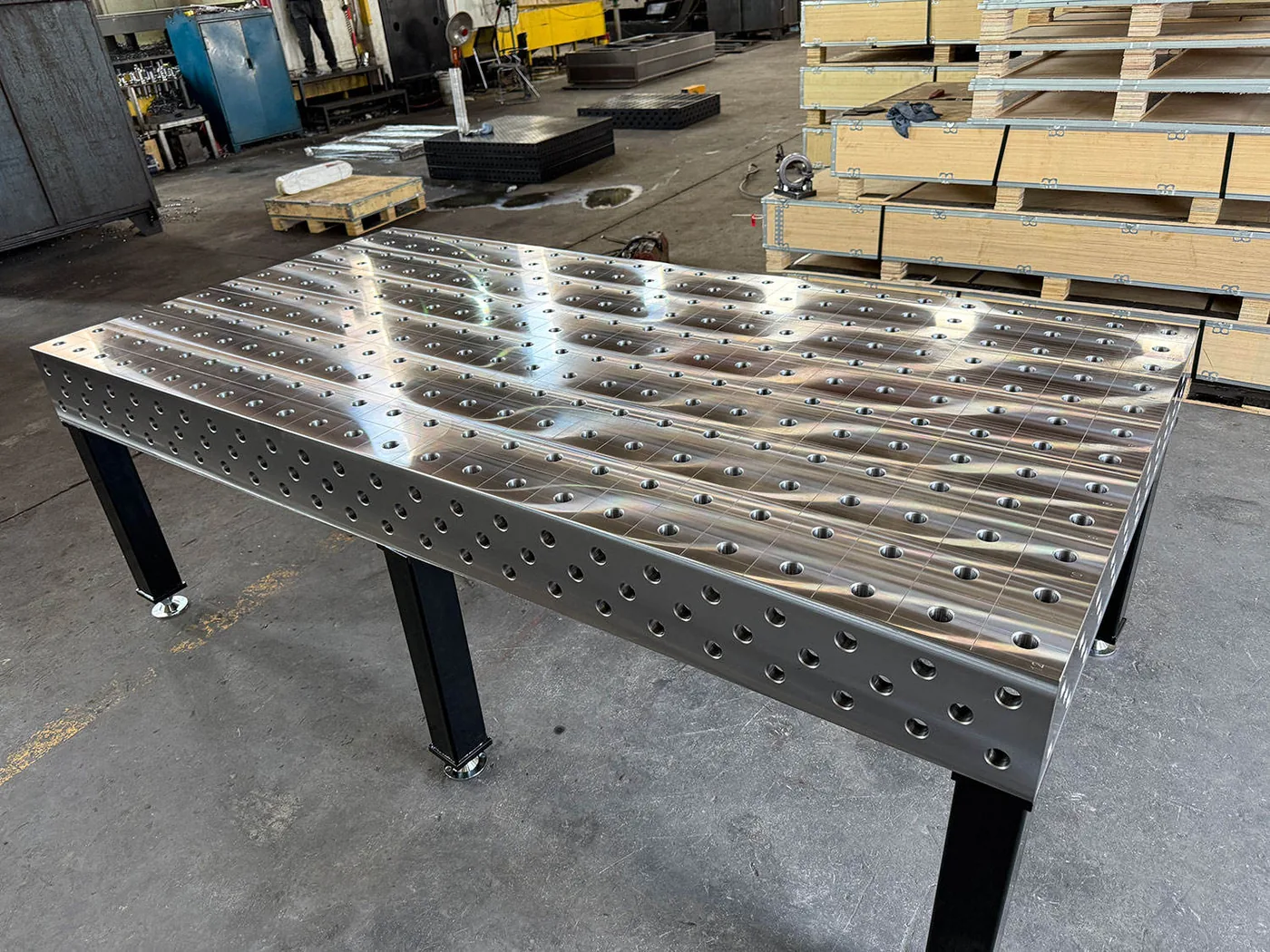
Scope is set by Annex I of the regulation, which lists goods by Combined Nomenclature code — not by industry or by what a product is called. Steel structures under heading 7308 and other articles of iron or steel under 7326 are already covered, at the subheadings listed in the annex. A fabricated steel table normally falls in that neighbourhood.
But a fixture system sold as machinery can be entered under Chapter 84 instead, and the machinery headings are not in Annex I today. The same object can therefore sit on either side of the line depending on how the customs entry is made. That is not a gap to be exploited: the code has to be correct for the goods, it is declared by the importer or their representative, and it is being examined closely as the scope widens. It is, however, a reason to agree the code with the buyer before the first shipment rather than discover two different codes on two shipments.
Two further points that exporters routinely get wrong. First, the obligation is the importer’s: the authorised declarant is established in the EU, applies through the CBAM Registry and buys certificates from its national competent authority. Second, the emissions counted for iron and steel in the definitive period are direct emissions; indirect emissions from electricity were part of transitional reporting, not of the charge for steel.
Where the carbon in a table actually sits
A welding table is mostly steel by mass, so most of its embedded emissions arrive with the steel rather than leave the fabrication shop. That single fact reorganises the conversation: the grade and the mill route behind the plate matter more than the electricity used to machine it.
Weight is the multiplier. A 200 mm platform body puts more steel into the same footprint than a 100 mm body — which buys internal reinforcement and stiffness, and also buys mass that is counted twice, once in freight and once in embedded emissions. A cast iron body is a different calculation again, because foundry melting is energy-intensive in a way that plate fabrication is not.
In the workshop, the process steps that consume energy are the predictable ones: stress-relief annealing of the welded body, shot blasting, five-face machining, and the surface treatment. Plasma nitriding adds process energy at the end of the route; rust-preventive oil adds almost none. None of these is large next to the steel, but they are the part of the footprint a fabricator actually controls — and the part a buyer can ask about without needing the mill’s data.
What your European customer will ask you for
Importers now build a per-shipment record, and the supplier is the only source for most of it. The list is shorter than it sounds, but each item has to survive a verifier.
| What is asked | Why it is needed | What good looks like |
|---|---|---|
| Installation identity and location | Emissions are declared per producing installation | A named site, not a trading company address |
| Production route | Fabrication steps and heat treatment drive direct emissions | A fixed route: fabrication, stress relief, machining, treatment |
| Precursor steel data | The steel input carries most of the footprint | Mill-level emissions data, ideally verified |
| Net mass per line | The declared quantity is net mass, per CN code | Weights that match the packing list |
| Verifier-acceptable emissions figure | Actual values need verification; otherwise default values apply | A documented method, not an estimate in an email |
The penalty for missing data is written into the rules
Where verified actual values are not available, default values apply, with a mark-up that rises each year — 10 per cent in 2026, 20 per cent in 2027, 30 per cent from 2028. Defaults are deliberately conservative. Over a few shipments they stop being a rounding error and start being a reason a buyer changes supplier.
One honest note on what a fabricator can and cannot produce today. The process route, the material certificates and the weights are documented and can be supplied with the shipment. Installation-level emissions data that a verifier will accept is a separate exercise, and most Chinese fabricators — this one included — are at different stages of building it. Ask any supplier directly which of the five items in the table above they can actually deliver, and treat a confident answer without documents as no answer.
The 50-tonne line is closer than it looks
The exemption is measured on the total annual net mass of CBAM goods a single importer brings in — steel, aluminium, cement and fertilisers counted together — not per order and not per product family. Electricity and hydrogen are never exempt, at any volume.
For a machine builder importing a few tables a year, 50 tonnes is comfortably out of reach: the threshold is crossed at roughly a few dozen tables, not a few. For a distributor, a system integrator, or a plant buying tables, fixtures, weldments and steel stock from several suppliers, the arithmetic is different, and the count is what the customs entries say rather than what the purchasing team remembers. It is worth doing the sum before assuming the exemption applies.
The 2028 question: welding tables in the downstream expansion
The scope is being widened, and the negotiation is live this month. On 17 December 2025 the Commission proposed COM(2025)989, adding roughly 180 downstream steel- and aluminium-intensive products from 1 January 2028 — machinery, metal goods, vehicle parts and appliances among them. The Council adopted a wider general approach on 12 June 2026; the European Parliament adopted its negotiating mandate on 15 September 2026 by 464 votes to 50, with a list reported at more than 400 product types.
The first trilogue took place on 20 October 2026 and ended without an overall agreement. A second round is expected on 30 November 2026, with the institutions aiming to conclude before the end of the year. Nothing is law yet, and the final product list will be a set of CN codes rather than a headline count. But the direction has been consistent across all three institutions, and the Commission’s proposal would calculate a downstream good’s embedded emissions from the emissions of the steel or aluminium it contains — which brings the argument back to the same place: the mill data behind the plate.
For a welding table already covered under 7308 or 7326, this changes nothing today. What it changes is the value of being ready: a fabricator that can trace plate to a mill with emissions data will be able to serve European buyers under either scope, and one that cannot will be quoting into a default value.
What to do before 30 September 2027
None of this is legal advice, and the rules are still moving — which is the reason to treat 2026 as a year for collecting data rather than a year for paying. The importers who will find 30 September 2027 unremarkable are the ones asking these questions now, while the answer is still an email rather than a correction.
- Confirm the CN code with your customs broker and use the same code on every shipment — and check it again if the 2028 scope is adopted.
- Do the 50-tonne sum across all CBAM goods the company imports in a year, not per product line.
- If the threshold is exceeded, start the authorised declarant application now; national authorities do not decide overnight.
- Ask the supplier for installation-level data, verified where possible, and for net mass per line that matches the packing list.
- Keep the mill certificates and the production route on file — they are the backbone of any later calculation, including a claim for carbon already paid upstream.
- Do not build a quotation on the assumption that an exemption will arrive; the temporary relief clauses under discussion are conditional, not automatic.