
The small-part problem: the table is bigger than the part
Put a 300 mm bracket on a table set up for 2000 mm frames and the difficulty is not holding force. It is reach. A clamp sized to hold a thick plate sits far from the corner you need to fix, and the stop you would use to set a datum is a hole or two away from where the datum actually falls.
The usual workaround is a spacer, a packing piece or a clamp positioned at an awkward angle. Each of those introduces something between the part and the table, and anything between the part and the table is a place where position can drift between one cycle and the next.
What D16 changes: holes and tooling sized for small geometry
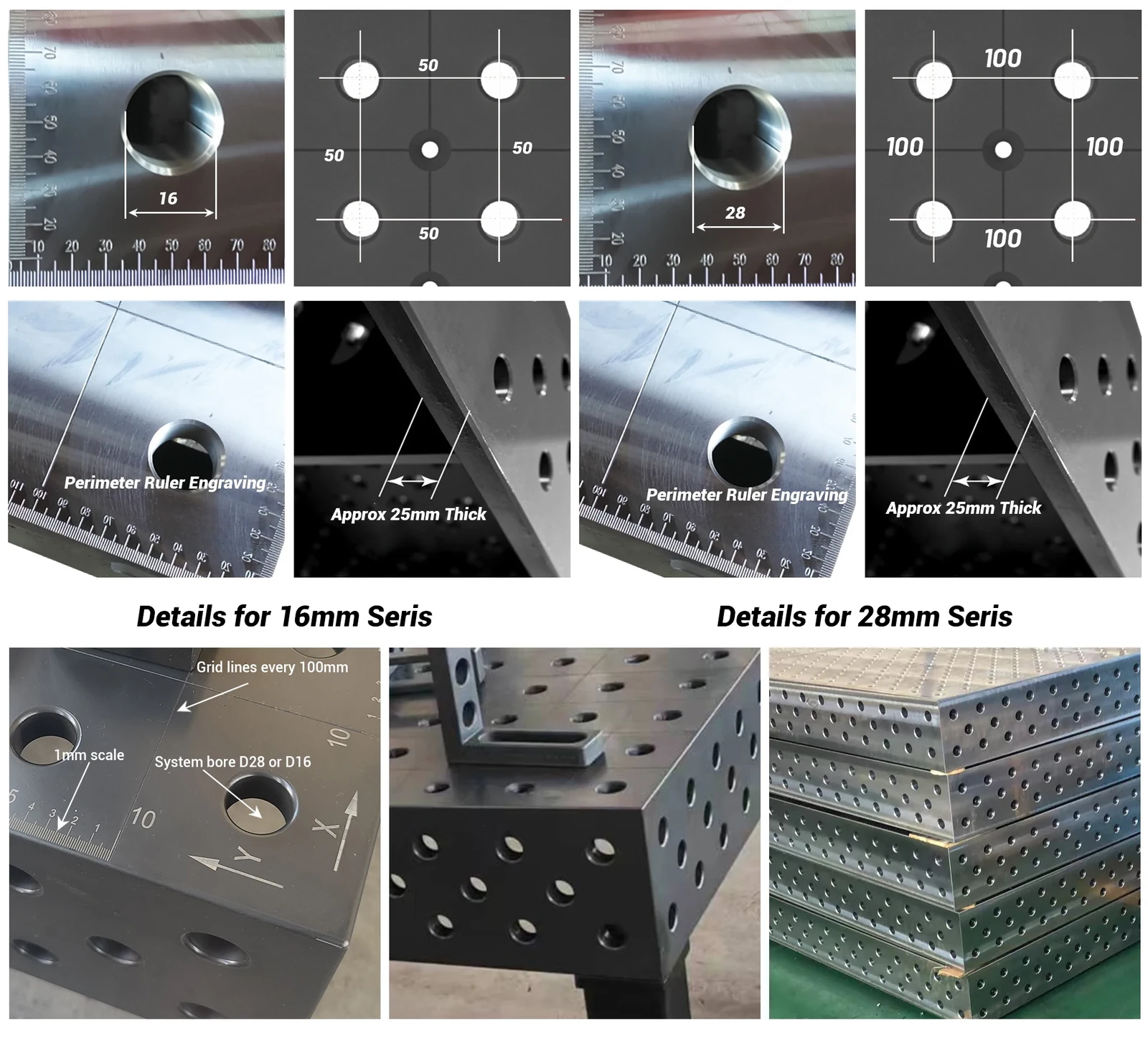
BECO tables are machined with 16, 22, 28 or 36 mm holes. The number is the hole diameter, and the tooling is matched to it: a 16 mm hole takes 16 mm pins, and the locating and clamping elements built around that diameter are correspondingly smaller in body and in jaw reach.
On a small part, that smaller tooling can sit where a heavier clamp physically cannot. The jaws close nearer the corner being welded, the stop is narrower than the joint, and the clamp body does not block the torch angle on the side you need to weld from. The gain is access, not tonnage.
Pairing D16 with 50 mm spacing
Hole diameter and hole spacing are two separate decisions. Spacing is available at 50 mm or 100 mm and is chosen independently of the diameter, so a D16 table can be built on either pitch.
On small work, the 50 mm grid does the more visible job. Stops and clamps sit closer to small geometry, so a datum lands within a shorter distance of the feature it references rather than at the nearest point on a coarse grid. For a part where two edges have to be set square within a small envelope, that difference is felt every cycle.
A 100 mm grid on a D16 table is still coherent when the parts are small but the operations are simple — repeat brackets that only need one stop and one clamp in roughly the same place each time. The finer pitch buys flexibility; the coarser pitch buys an open surface between holes.
Where D16 reaches its limit
The relationship between hole size and capacity runs one way: larger holes take larger pins and clamps, so a D36 grid accepts the heaviest tooling in the range, and positioning density falls as diameter rises. Turned around, the D16 grid is the finest and takes the lightest tooling.
That makes it the wrong platform for thick plate, heavy fabricated frames and structures where holding force decides whether the joint pulls. Those belong on D28, or on D36 in the heaviest cases. A shop that runs both small precision assemblies and heavy frames is usually better served by two stations than by one table asked to do both.
| Work | What decides it |
|---|---|
| Small brackets, thin-section frames | Tooling has to reach small geometry: finer grid helps |
| Mixed small and medium parts | A middle system covers both without a second table |
| Thick plate, heavy frames | Holding force matters more than positioning density |
Deciding from the workpiece, not from the catalogue
The hole system is chosen from the workpiece and the clamping load, and confirmed at quotation rather than assumed from a price list. The useful input is the part: its smallest feature, the thinnest section being welded, the corners that need clamping and the sides that need to stay clear.
If the answer is D16, the spacing question follows on the same drawing. Send both together with the part dimensions and the quotation is built around the work rather than around a stock size.