
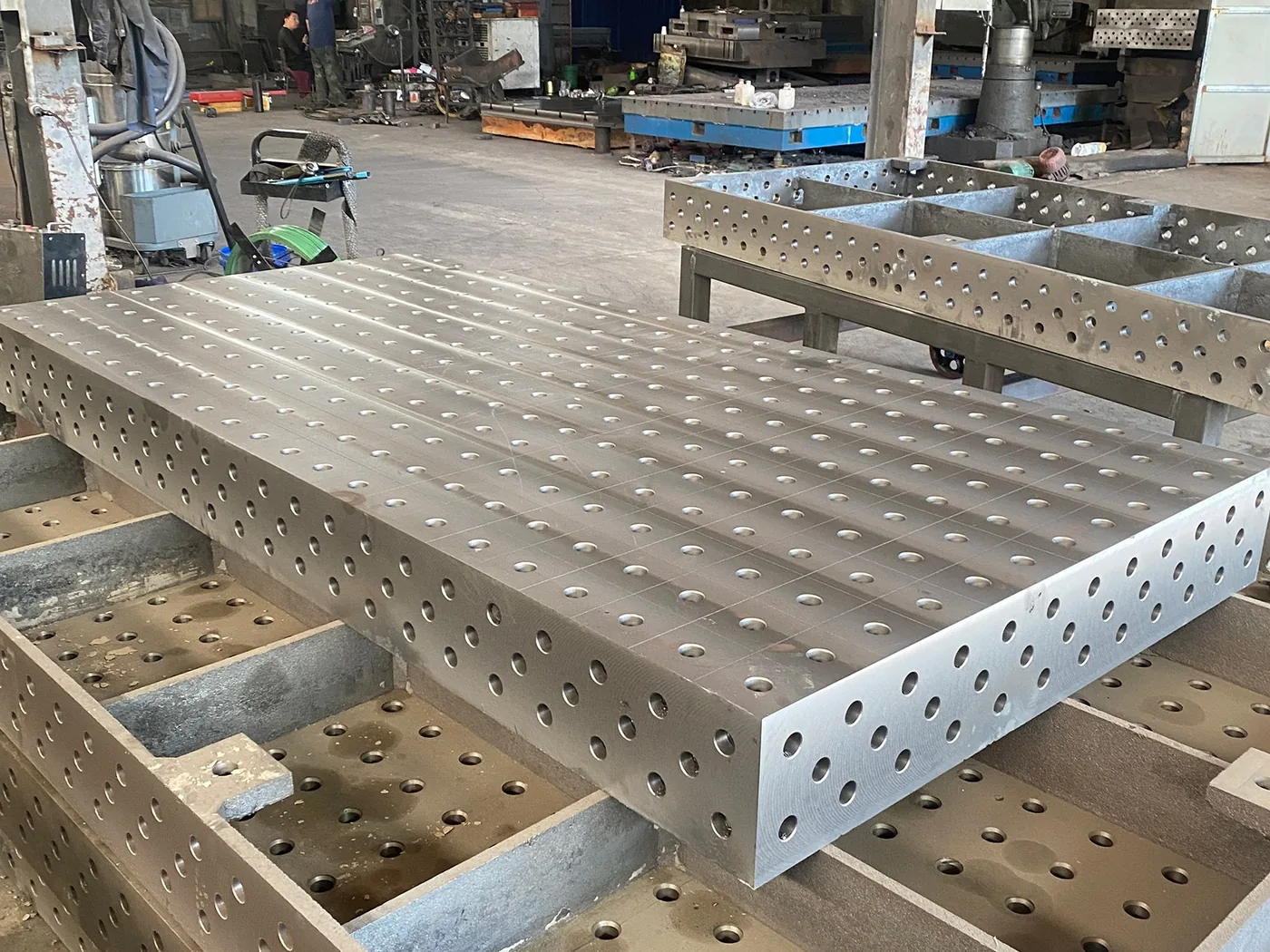
Why two quotations for a similar table differ
A welding table is a stack of decisions, and each decision has a cost. When two prices diverge, the useful question is not who is cheaper but which decisions changed. Almost always the answer sits on one of four lines that a specification sheet lists but rarely explains.
The comparison only becomes meaningful once both quotations describe the same decisions. Otherwise the lower number is buying less table, not a better price.
Machined faces: one face or five
What makes a table 3D is the hole grid carried on the top plus four side faces. That is also the first cost line: machining one face and machining five are different jobs, with different setup time and different inspection work.
The five-face configuration exists for a reason — side faces let curved parts and vertical assemblies be referenced against the grid rather than against a clamp. If the work never leaves the horizontal plane, five faces are cost without benefit. If it does, one face leaves the fixture plan short.
Flatness grade: the machining time hidden in a number
Flatness is stated in three steps: 0.1 mm/m2 as standard, 0.05 as precision, 0.02 as high precision. Each step up is more machining time, more checking, and a higher rejection risk on the casting or weldment underneath.
Over-specifying flatness costs that time without improving a looser assembly. A table used for general frames does not become a better table at 0.02; it becomes a more expensive one. The grade should follow the tolerance the assembly actually needs.
Size and thickness: material, handling and floor space
Table sizes run from 500 x 500 mm to 4000 x 2000 mm, and platform height is 100 or 200 mm with custom heights available. Every step up in size adds material, adds machining area, and adds weight that has to be lifted, moved and shipped.
Thickness is part of that line, but thickness and rigidity are not the same word. A thick plate on a light frame still deflects under load; the structure carries the work as much as the top does. Quotations that list only plate thickness are describing one input, not the result.
Hole system and accessories: what is included, what is not
The hole system — D16, D22, D28 or D36 — sets hole diameter and spacing, and with them the size of the tooling that can be used. A finer system means more holes to machine; a coarser one means heavier tooling bodies that must fit between the holes.
The larger variable is usually what the quotation includes. A price for the platform alone and a price for the platform with locating, clamping and support elements are not the same offer. Comparing them without noticing the difference is the most common mistake in this category.
Reading a quotation line by line
Put the two documents side by side and check four things in order: faces machined, flatness grade, size with height and thickness, hole system with the accessory list. Where they match, the prices should be close. Where they differ, the difference is the answer.
A supplier who can explain which line changed, and why, is describing a process rather than defending a number. Production for a machined platform runs through fabrication, stress relief, shot blasting, five-face machining, inspection, treatment and packing — each stage is where a specification decision turns into cost.