
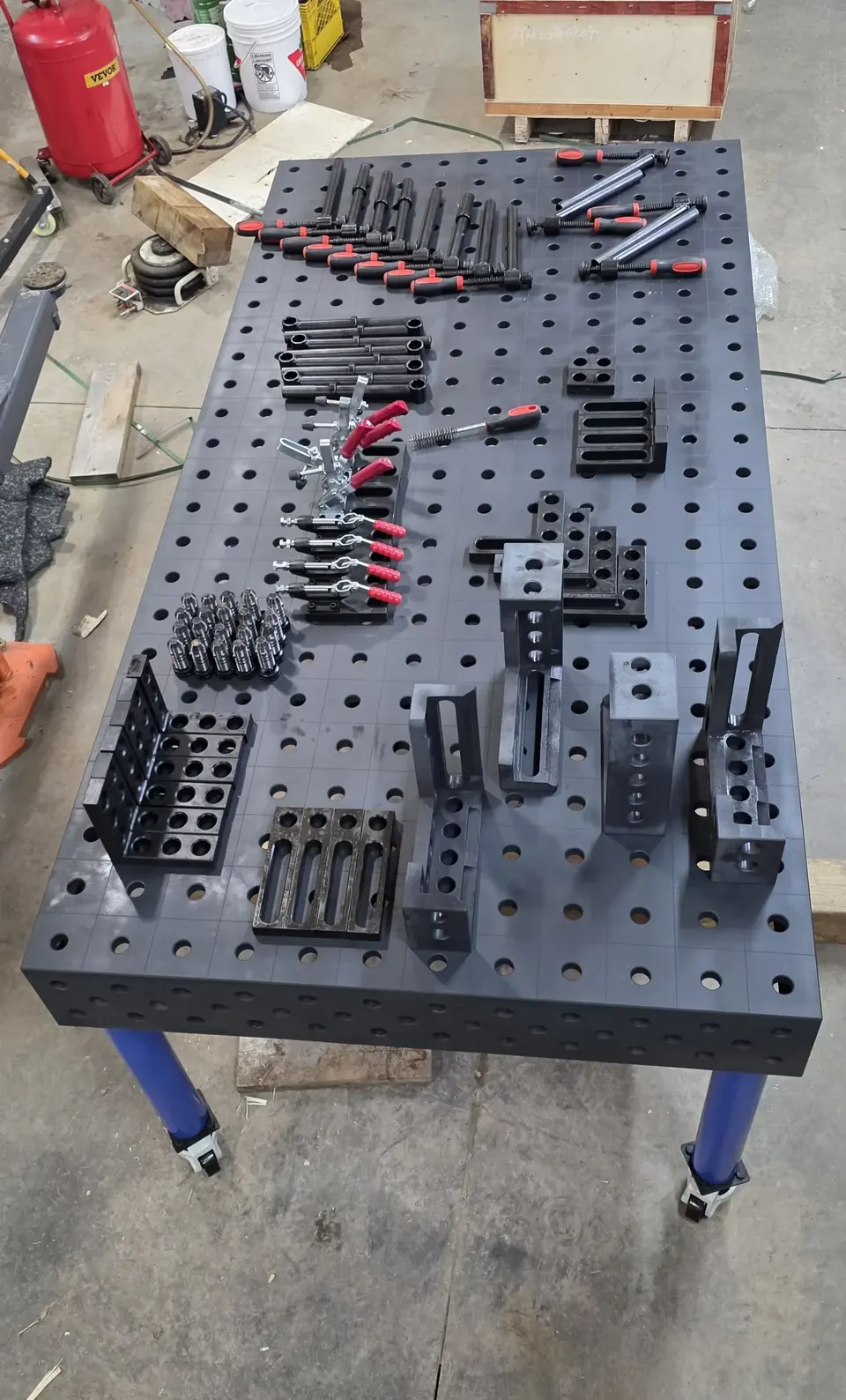
Two fixture philosophies in one workshop
A dedicated fixture is purpose-built for one part: designed, welded or machined to that geometry, and fastest at building exactly that part forever. A modular fixture is a strategy: the table grid plus reusable clamps, stops and supports, arranged for the current job and rearranged for the next.
The difference shows the first time something changes. A modular setup repositions between cycles — a clamp moves, a stop gains a position, the whole fixture adapts with bolts. A dedicated fixture changes by machining or rebuilding, which is a project rather than an adjustment.
What modular does well
- Change: new products, revised parts and short runs reuse the same table and tooling.
- Repair and improvement: fixtures for robot work are refined after the first articles; bolted tooling adjusts between shifts.
- Discovery: a new job can be fixtured, tested and corrected without committing to permanent tooling.
- Asset life: the table keeps its value across every product the shop will ever run.
What dedicated fixtures do well
At maximum repetition of one mature, stable design, a purpose-built fixture is hard to beat: the fastest loading, the fewest operations, no assembly of the setup each morning. That is why high-volume lines run dedicated tooling even in shops that own modular tables.
The honest caveat is the same from every shop that has run both: a dedicated fixture is a bet that the part will not change. When the part does change, the bet is paid in machining hours.
The hybrid reality of most shops
In practice the two philosophies share the floor. The modular table carries the work while a product is young — while the weld sequence is being learned, the distortion mapped, the clamps argued over. When the design stabilises and the volume justifies it, elements of the modular setup can be replaced by dedicated details one at a time, while the grid keeps carrying the rest.
The reverse path is also common: a modular setup becomes the master, and dedicated fixtures are built to match its positions when a part graduates to full production elsewhere in the shop.
A decision list by product mix
- Product churns or grows — modular.
- One stable part at high volume — dedicated earns its keep.
- Products repeat in families — modular base, dedicated details where the repetition pays.
- Repairs and revisions are routine — modular, because rework is repositioning.
- Accuracy depends on the setup discipline more than the fixture style (pins seated, clamps torqued, datums clean) — either way.