
What is in force, and since when
The sequence is documented. On 13 April 2026, Parliament and Council negotiators reached a provisional agreement on measures to counter the effects of global steel overcapacity on the EU market, according to the European Parliament press release of that date. The plenary backed the regulation in May 2026 by 606 votes to 16, with 39 abstentions, and the regime replaced the safeguard that had been in place since 2018 when that safeguard expired on 30 June 2026. It has applied since 1 July 2026.
The numbers in force: tariff-free import volumes are capped at 18.3 million tonnes a year, which the negotiating parties described as a 47 percent reduction compared with 2024 steel quotas. Imports above the quota carry a 50 percent customs duty, up from 25 percent under the previous arrangement. Trade reporting via Eurometal puts the exact legal figure at 18,345,922 tonnes. A melt-and-pour declaration requirement has applied on top of this since 1 October 2026, which we covered separately.
How the quota year is divided
The cap is not one pool. Half of the quota, about 9.15 million tonnes, is reserved for partners with free trade agreements; the other half is open to most-favoured-nation suppliers. Partners that supplied at least 5 percent of EU imports between 2022 and 2024 receive country-specific quotas, and once a country exhausts its allocation, the 50 percent duty applies to volumes above it.
Quotas are managed quarterly. Unused quota carries over into the next quarter, but that flexibility ends on 30 June 2027, when the Commission review follows. In November 2026, trade press reported that the Commission published the country-specific quota allocation for 1 July to 31 December 2026, allocated on 2022-2024 import shares and managed first-come-first-served. The exact product-category breakdown differs between sources, so the number worth tracking is the country allocation, not the category count.
Why a welding table order sits inside this
A welded steel table is a fabricated steel article, and fabricated articles sit downstream of every measure in this regime. Whether a specific consignment counts against a quota category, and at what rate the over-quota portion is charged, depends on its customs classification — that is a question for a customs broker, not something a supplier can promise from the workshop floor. What the buyer can plan is the calendar.
The regime converts timing into exposure. A consignment that clears customs early in a quarter competes for quota that is still open; one that arrives after a country allocation is exhausted faces the 50 percent duty on the portion above quota. Because carry-over between quarters ends on 30 June 2027, the second half of 2026 and the first half of 2027 are the period when quarterly planning actually buys something. After the mid-2027 review, the rules may differ.
What a buyer should do differently
- Ask for the Mill Test Certificate with the melt-and-pour country and heat number on every line item. Since 1 October 2026 the importer declares this at customs; the evidence has to come from the mill, and transitional alternative documents are only accepted until 30 September 2027.
- Place orders early in the quarter rather than late. Fabrication takes roughly ten days for a standard configuration, so an order placed at the start of a quarter can still clear customs inside the same quota window; an order placed in the final weeks cannot.
- Get the landed cost quoted as a range, not a number. The difference between clearing inside the quota and above it is the 50 percent duty on the over-quota portion, and that spread belongs in the comparison between suppliers, not in a surprise after arrival.
- Consider a sectional design for a very large work area. Sections ship as separate consignments, which spreads customs entries across quota windows — and the transport argument for sections already stands on its own.
- Put the mid-2027 review in the calendar. The Commission must review the regime, and carry-over flexibility ends on 30 June 2027; commitments that extend past that date should not assume the current flexibility.
What this does not change
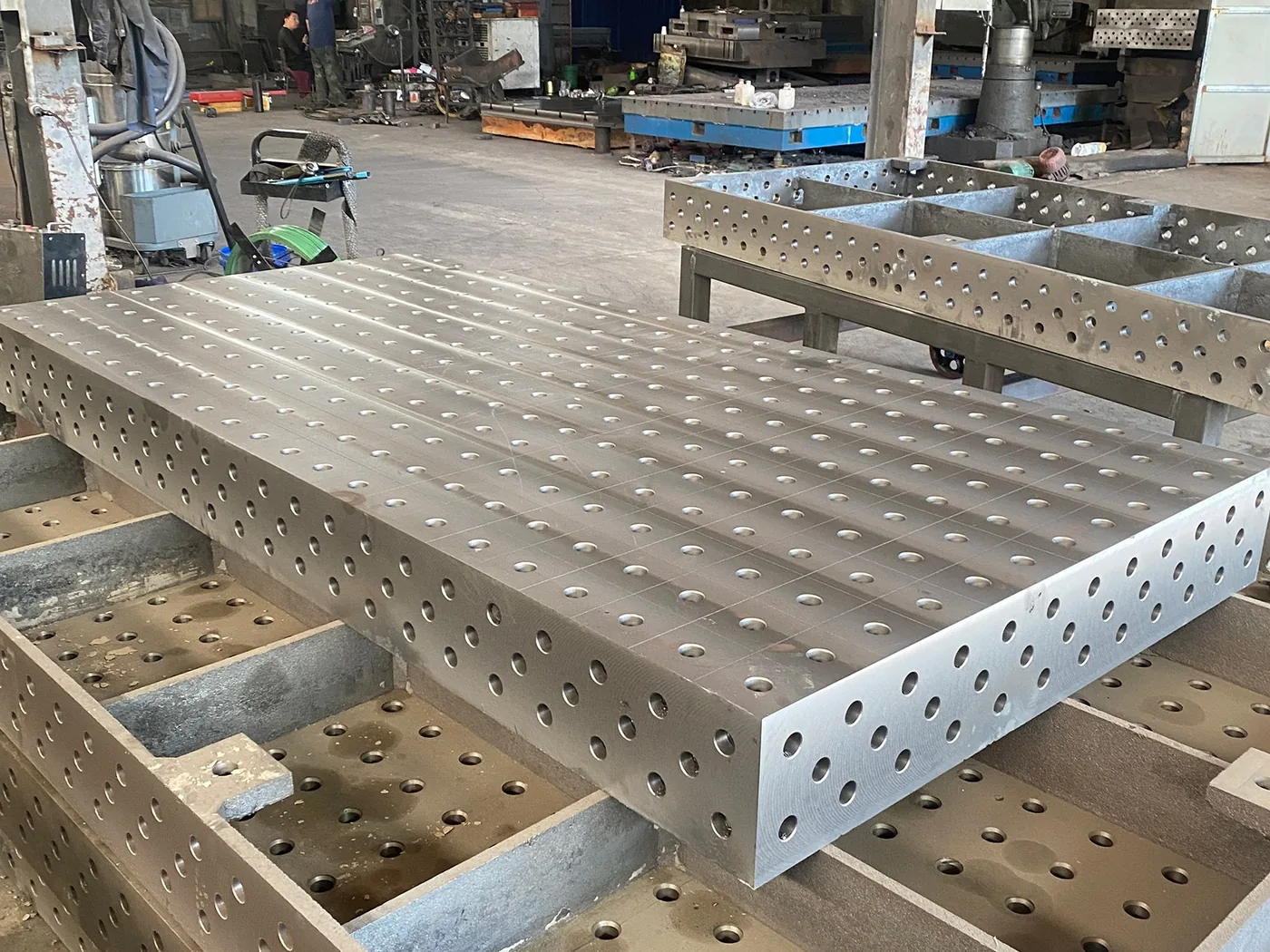
None of this touches what happens inside the factory. The table is still cut, welded, stress-relieved, machined, drilled and inspected to the specification agreed in the drawing: sizes from 500x500 to 4000x2000 mm, platform height 100 or 200 mm, materials Q235, Q355, HT250 or HT300, hole spacing 50 or 100 mm. The quota regime changes the paperwork and the calendar at the border, not the build.
That is also why the specification discipline matters more now, not less. A table specified to a documented hole system and a stated flatness grade can be re-ordered in a later quarter without renegotiation, which is exactly the flexibility a buyer needs when the customs side of the calendar has become less predictable.