
What the October 2026 forecast actually says
The World Steel Association (worldsteel) released its Short Range Outlook for 2026 and 2027 on 12 October 2026, based on data available to early September 2026. Global steel demand is forecast at 1,722 Mt in 2026, essentially flat against 2025, before growth of 1.7 percent to 1,752 Mt in 2027. Both figures are downward revisions from the April 2026 round, which had expected modest growth this year and 2.2 percent next year.
The revision is almost entirely a China story. worldsteel now expects Chinese steel demand to fall 2.0 percent in 2026 and a further 1.0 percent in 2027, citing a property downturn that has not decelerated as assumed and infrastructure investment that stayed in negative territory. Outside China the picture is different in both directions at once: demand grows 1.5 percent in 2026, then accelerates to 4.0 percent in 2027, a rate the association describes as rarely seen in recent years. Developing economies excluding China grow 1.9 percent in 2026 and 5.1 percent in 2027. India remains the fastest-growing major market at 172.4 Mt in 2026, up 7.9 percent, and 186.2 Mt in 2027, up 8.0 percent. The Gulf is the exception: demand there falls about 11 percent in 2026 after rising 17.7 percent in 2025.
Two limits belong with those numbers. The forecast is demand, not price, and it is a projection that has already been revised once in six months. It also carries an explicit caveat about energy-market disruption from the unresolved conflict in the Middle East, which the association says has left less buffer for the next shock.
Why a demand number reaches a welding table delivery date
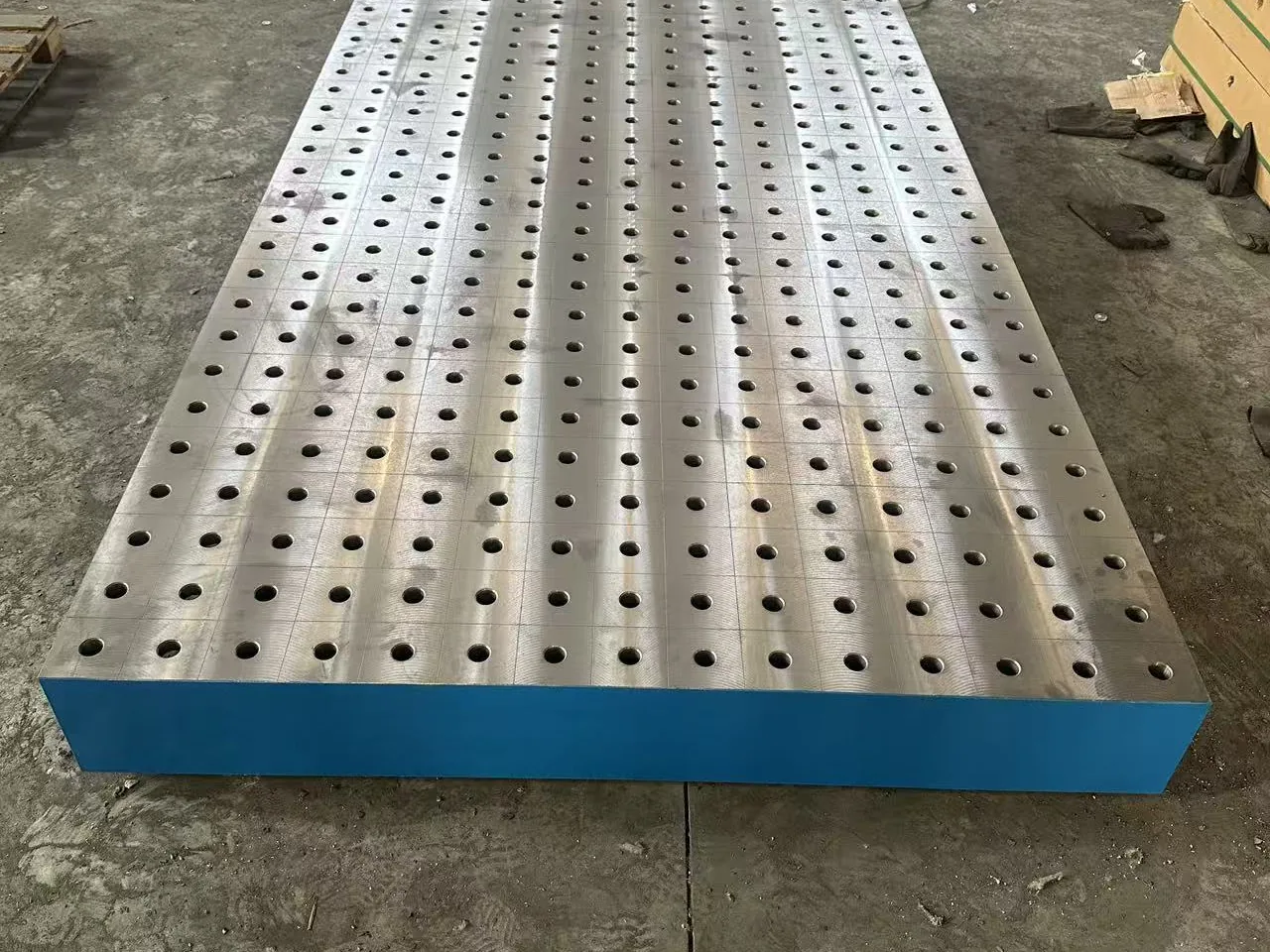
A welding table is a small item in a steel mill book and a large item in a machine shop schedule. The plate is a commodity line; the table is a sequence of operations that each need a slot: cutting, welding of the frame and ribs, stress relief, machining of the top, drilling or tapping the hole grid, surface treatment, inspection, packing. When regional demand steps up by four percent in a year, the constraint that appears first is rarely the steel itself. It is the queue in front of the machining centre and the heat-treatment furnace, because those are shared with every other fabricated product in the same supply base.
That is why the useful reading of the October forecast is a calendar question. A buyer who needs tables installed in the first half of 2027 is competing for capacity with every other fabricator that read the same forecast and moved earlier. A buyer who orders into a flat 2026 order book is buying in the quieter half of the cycle. Neither timing is guaranteed to be cheaper, but the second is measurably easier to schedule, and easier to hold to a date.
What tightens first, in order
None of those rows is a price. Each of them is a queue, and a queue is what an order actually waits in. The reason to plan around them is that they are the parts of a table order a buyer can still influence after the enquiry is sent.
| Stage in a table build | What a demand ramp does to it | What a buyer can control |
|---|---|---|
| Plate and section supply | Mill allocations shift toward contract volumes; odd sizes wait longer | Standard sizes and standard heights, agreed early |
| Machining of the top | Shared with every other fabricated product; the first queue to lengthen | Flatness grade matched to the job, not to the catalogue maximum |
| Stress relief before machining | Furnace slots are batch-loaded; a missed slot pushes machining | Design that allows batch loading, sectional tops for large areas |
| Hole grid drilling and tapping | Programme time scales with hole count and hole type | 50 or 100 mm spacing chosen for the fixture plan, not by default |
| Surface treatment and packing | Nitriding and black oxide add a pass; export packing adds days | Treatment specified for the shipping route and storage time |
Specify for a shorter lead time, not only for a lower quote
- Stay inside the standard size range where the job allows it: 500x500 mm up to 4000x2000 mm, with platform height 100 or 200 mm. A size inside that range reuses existing programmes and fixturing; a size outside it starts from a drawing.
- Choose the flatness grade the work needs. 0.1 mm/m2 is the standard grade, 0.05 mm/m2 is the precision grade and 0.02 mm/m2 is the high-precision grade. Specifying 0.02 mm/m2 for a table that will carry tacked frames buys machining time and nothing else.
- Pick the hole spacing from the fixture plan: 50 mm gives finer positioning, 100 mm gives faster drilling and a cheaper top. Hole diameter 16, 22, 28 or 36 mm and plain or threaded bores change the machining route as much as the hole count does.
- Use Q355 where weight matters. A higher-strength grade lets a lighter section carry the same load, which is paid back twice: once in plate and once in freight. Q235 remains the right answer where the table is a flat reference surface and stiffness is not the constraint.
- For a very large work area, ask for a sectional design. It transports in pieces, installs in pieces, and if one section is damaged the replacement is a section rather than a table.
Where the growth is, and what it means for a specification
India is the fastest-growing major steel market in the forecast, at 7.9 percent in 2026 and 8.0 percent in 2027, driven by infrastructure, private real estate and expanding machinery capacity. For a buyer with Indian operations or an Indian fabricator in the supply chain, the practical consequence is that local capacity will be busy and that a table specified to a documented hole system travels better than one specified to a drawing that only exists in one shop. A known grid, a known height and a known hole type are what make a table re-orderable in a second country.
The Gulf runs the other way in 2026, down about 11 percent after a 17.7 percent rise in 2025. A market that has just absorbed a large amount of capacity is a market where fabrication slots are available, which shortens the calendar even when the demand headline is negative. Reading the regional split is more useful than reading the global total.
What to put in the enquiry so the date holds
A standard configuration is quoted and built in roughly ten days. Custom work is not a longer version of the same thing: it starts when the drawing is frozen, and every week the drawing stays open is a week added to the end. In a year when demand outside China is forecast to grow four percent, the drawing is the part of the schedule a buyer still owns.
- The largest workpiece, by its diagonal, and the fixture plan for the first three parts. Size follows the part, not the average.
- The flatness grade you will actually inspect against, and the method you will use to check it.
- Material and surface treatment, with the storage and shipping conditions that decide between rust-preventive oil, black oxide and plasma nitriding.
- Whether the order is a single table or a batch, and whether the second batch must be interchangeable with the first.
- A required-on-site date rather than a required-ship date, so that packing and freight are inside the plan instead of after it.