
April 2026: the duty basis changed to full customs value
Proclamation 11021, issued on 2 April 2026 and published at 91 FR 18201, restructured the Section 232 regimes for steel, aluminium and copper. Its central change took effect for goods entered on or after 6 April 2026: the additional ad valorem duty on steel articles and steel derivative articles applies to the full customs value of the imported product, regardless of how much of that value is steel.
The default rate for steel articles became 50 percent, with a lower 25 percent rate applying to product of the United Kingdom whose steel content was melted and poured in the UK. The practical consequence is easy to state: a fabricated article that is 60 percent steel and 40 percent machining, fixturing and margin is now taxed on 100 percent of its invoice value. Under the pre-2026 rules the duty could be computed on metal content only; that door has closed.
June 2026: differentiated rates by origin
A further presidential proclamation in June 2026 adjusted the rate structure with effect from 8 June 2026, running to the end of 2027. The additional Section 232 rate became 25 percent unless a lower rate applies. For products of a listed group of jurisdictions — Argentina, Ecuador, El Salvador, Guatemala, Japan, Korea, Liechtenstein, Switzerland, Taiwan (China), the United Kingdom and the EU member states — the sum of the ordinary Column 1 duty rate and the additional Section 232 rate is capped at 15 percent where the Column 1 rate is below 15 percent.
Two carve-outs matter to anyone comparing origins. Derivative articles whose steel content was entirely melted and poured in the United States carry a 10 percent rate — an incentive to source fabrication work from domestically melted steel. For Canada and Mexico, USMCA-qualifying goods pay the 25 percent rate only on their non-US content, with a floor of 15 percent on the total effective duty.
The June proclamation also schedules a further rate change for articles listed in its Annex I-C effective 1 January 2028. A landed-cost model built today should be dated, not treated as permanent.
August 2026: the derivative list is proposed to grow again
Proclamation 11021 authorised the Secretary of Commerce and the US Trade Representative to add derivative articles to the scope of the Section 232 duties. The Bureau of Industry and Security used that authority in a Federal Register notice published on 6 August 2026 (91 FR 50756, Docket BIS-2026-0331), proposing to include 14 additional derivative articles within the scope of the steel, aluminium and copper duties.
The list is wide: aluminium powder, brass-wind musical instruments, parts of welding machines and apparatus (HTSUS 8515.90.2000), floor safes, certain electric conductor cables, fire extinguishers, parts of heat exchange units, parts of certain hydraulic engines and motors, self-propelled cranes and mobile lifting frames, tanker trailers and semi-trailers, agricultural trailers, other trailers and semi-trailers, and certain filled steel containers. Proposed rates are mostly 25 percent, 15 percent for agricultural self-loading trailers, and 50 percent for steel containers filled with propane, oxygen or propylene — computed on the container metal value only.
The public comment period closed on 27 August 2026. As of the date of writing, no final inclusion decision for those 14 articles has been observed in the Federal Register, and the notice itself is a proposal, not law. That distinction matters: quoting a rate from the proposal as if it applied today would be wrong, but ignoring the direction of travel would be worse.
Where a welding table sits in this structure
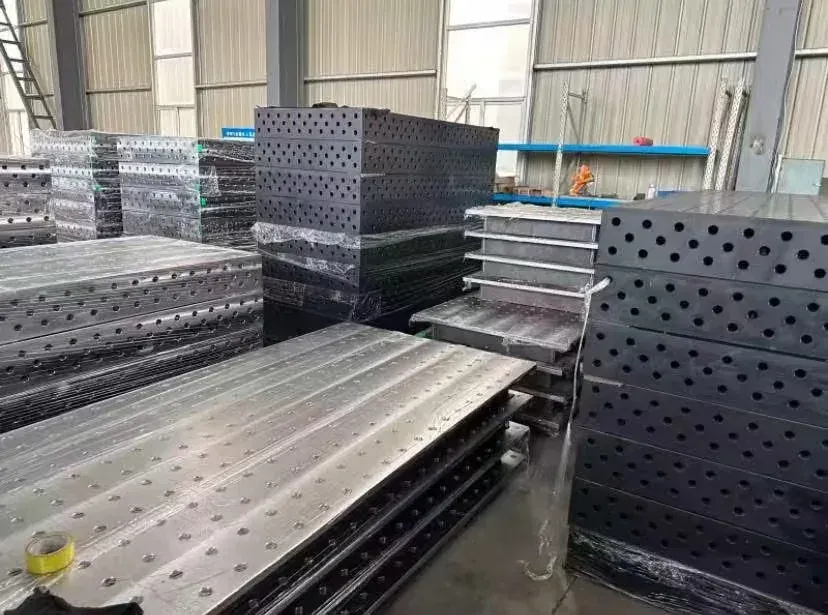
A welding table is a fabricated steel article, and its customs treatment depends on the HTS classification of the specific goods — steel structures and articles of iron or steel sit in the chapter 73 neighbourhood, while a fixture system sold as machinery can be entered under chapter 84. The classification is made by the importer on the entry, which is why the code should be agreed in writing with the customs broker before the first shipment rather than reconstructed after a customs query.
The full-customs-value rule changes the arithmetic that used to favour specifying more steel. Under a metal-content basis, a heavier table paid more duty than a lighter one. Under the April 2026 basis, the duty is computed on the invoice value either way — so the value a buyer adds through machining quality, hole-system accuracy and fixturing completeness is inside the duty base too. Budgeting 50 percent of the invoice value for a China-origin steel article is the conservative planning figure; the exact rate depends on the classification and on any additional measures that stack on top of Section 232.
One related point for buyers who also import welding machines: the proposed 8515.90.2000 line covers parts of welding machines and apparatus, not workholding. A fixture or table is not a welding machine part. But the inclusion process that produced this proposal is ongoing and periodic — each round can pull adjacent categories into scope, and fabricated metal goods are the natural candidates.
What to confirm before the next order
None of this is legal advice, and classification questions in particular belong with a licensed customs broker. The durable takeaway is narrower: the cost of importing a steel-intensive product into the United States is now driven by paperwork — the classification, the declared value and the mill-level traceability — at least as much as by the steel price. A fabricator that can hand over a clean file on all three shortens every conversation downstream.
- Get the HTS classification in writing from the supplier and validate it with your customs broker; the code drives both the Section 232 question and any anti-dumping exposure.
- Rebuild the landed-cost model on full customs value at the applicable rate, and date it — the June proclamation schedules another rate change for 1 January 2028.
- Compare origins on the same basis: for the listed partner jurisdictions the combined ordinary duty plus Section 232 additional duty is capped at 15 percent, which narrows the gap that a freight calculation alone would suggest.
- Ask the fabricator for melt-and-pour traceability on the plate — mill, heat number, certificate. The US reporting system asks for the same mill-level data the EU regime formalised, and a supplier that can answer for the EU file can answer here too.
- Track the BIS inclusion process on regulations.gov (Docket BIS-2026-0331) rather than relying on commentary; the final Federal Register notice is the only trigger that changes duty rates.