
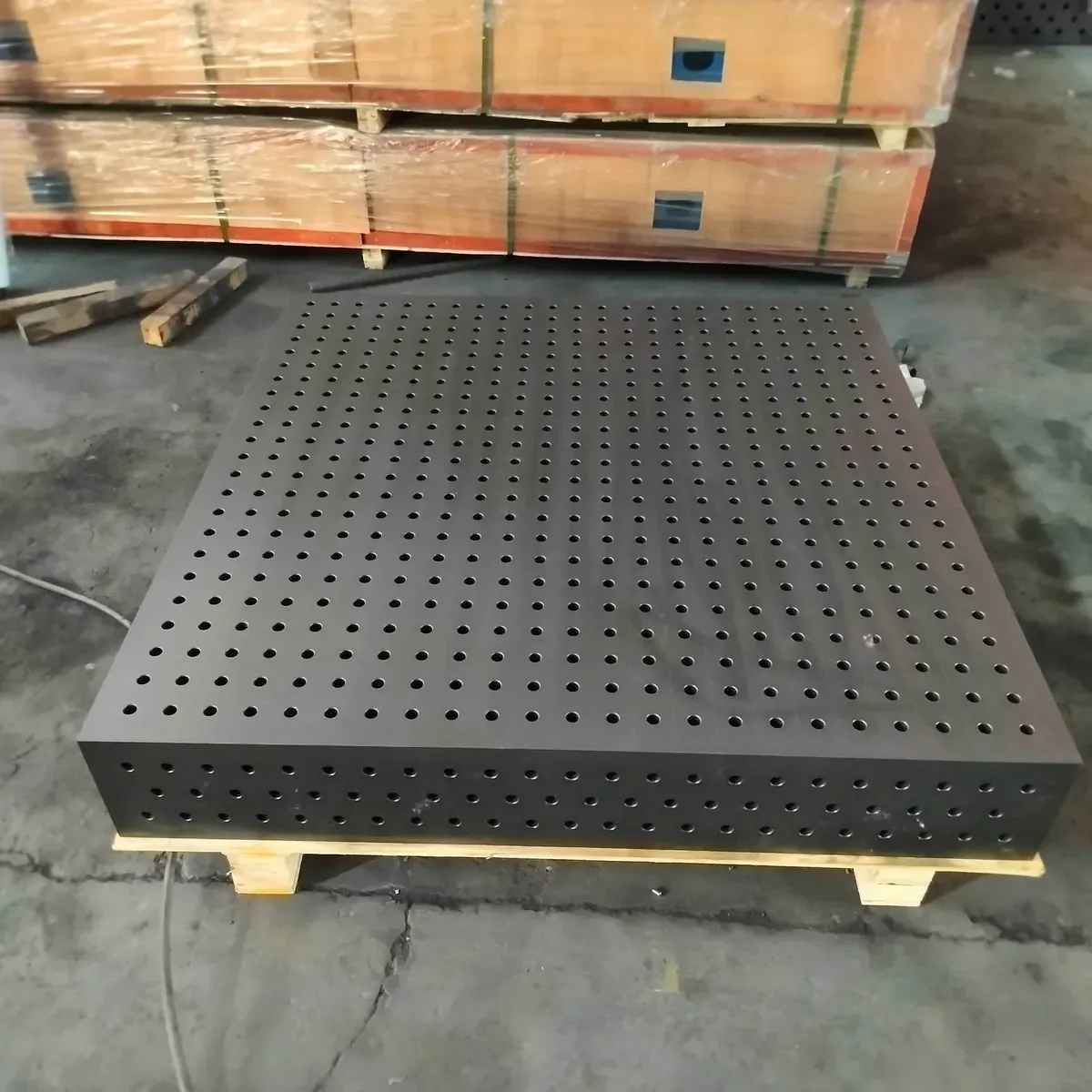
When a top-only order makes sense
A 3D welding table is two parts: the machined platform with its hole grid, and the frame that holds it at working height. Most buyers order both together, but there are good reasons to buy the welding table top only:
- You already own a stiff frame, for example an old bench base or a welded stand built for your floor.
- The top goes into a robot cell or onto a positioner, where the integrator designs the base around the robot reach.
- The top sits on a machine base or a larger weldment as a fixture plate.
- You are replacing a worn plain bench top with a modular, drilled surface.
- You want a smaller crate: a top without legs packs flatter and is easier to unload.
If you have none of these, a complete table is usually simpler, because the frame is designed and levelled for the top from the start. See welding tables for sale for complete configurations.
What you actually get with a 3D table top
A 3D welding fixture table top is not a flat plate. It is a box-shaped platform: a thick top plate with welded side walls, machined on the top face and on the side faces, with the hole grid running across all of them. That is what lets clamps, stops and squares fix work in three directions. See what is a 3D welding table for the full system.
Platform height: 100 or 200 mm
The side wall height is the platform height. A 100 mm body is lighter and easier to mount on an existing frame. A 200 mm body gives more side-face area for clamping and a stiffer top, which matters when the top spans a wide frame. Our guide to platform height 100 or 200 mm explains the trade-off.
Top plate thickness
Buyers often ask about welding table top thickness. On a 3D platform, plate thickness is matched to the hole system: heavier systems use a thicker plate so that pins and locking bolts seat fully in the bore. Thickness is confirmed on the drawing for each configuration, so ask for it on the quotation if your existing tooling needs a specific plate depth.
Choose the hole system and surface first
The hole system decides which clamps and stops fit, so it comes before everything else:
- D16: 16 mm holes on a 50 mm grid, for light parts, thin sheet and dense positioning.
- D22: 22 mm holes on a 100 mm grid, an all-round choice for mixed fabrication.
- D28: 28 mm holes on a 100 mm grid, for heavy frames, thick plate and high clamping force.
If you already own accessories, match the top to them. For the surface, choose machined steel or a nitrided face, which is harder and resists spatter and rust. The D16, D22 or D28 guide compares the systems in detail.
Mounting the top on your own frame
Agree the mounting interface
Tell us how the top will attach: bolt-down points under the platform, mounting plates on the side walls, or a frame we should match. With a drawing of your frame, the mounting points can be placed where your frame has support, not where the standard legs would go.
Check frame stiffness and levelling
A machined top only stays flat if the frame under it is stiff and level. Support the top at enough points that it cannot sag between them, and give the frame adjustable feet so it can be levelled on an uneven floor. See levelling a welding table.
Bolt it, do not weld it
Welding a machined platform to a frame puts heat into the top and can pull it out of flat. Bolt the top down, so it can also be removed, re-levelled or moved to a new frame later.
Top only or a complete table?
| Top only | Complete table | |
|---|---|---|
| Frame | Your own frame, cell base or machine | Matched legs or castors supplied |
| Levelling | Done on your frame | Levelling feet supplied |
| Best for | Robot cells, existing benches, integrators | New welding stations |
| Crate | Flatter and smaller | Larger, legs packed separately |
| Engineering on your side | Mounting and frame stiffness | Very little |
Integrators fitting tops into automated cells can also read welding fixture tables for robotic cells.
What to send for a top-only quote
- Top size: length and width in mm or inches.
- Hole system, or the brand and system of the accessories you already own.
- Platform height: 100 mm, 200 mm or custom.
- Surface: machined steel or nitrided.
- How the top mounts: a drawing or photo of your frame, cell base or machine.
- Quantity and delivery destination.
Send a drawing for a quote
The fastest way to a firm quotation is a drawing or a sketch with dimensions. For a top-only order, include the frame or cell base the top will sit on. Upload it through the contact form or email it, and we will reply with a configuration and a quotation. Standard sizes usually produced in about 10 days after drawing approval; custom sizes are confirmed on the quotation.
Distributors and resellers who want to stock BECO tables and tooling can see the terms on the distributor page.