
What the holes actually do
A hole on a 3D welding table does four jobs:
- Clamping. Quick clamps, vertical clamps and toggle clamps drop into a hole and lock, so force is applied straight down onto the part from wherever you need it, not only at the edge of the table.
- Locating. Stops, angle squares and locating bars are pinned into holes at known positions. They set the datum edges of the part before any clamp touches it.
- Connecting. Quick-locking pins and slot bolts join angle squares, extensions and even a second table into one rigid setup.
- Supporting. Support blocks and U-shaped boxes sit in the grid to raise round or awkward parts to the right height.
Because every hole is machined at a known spacing, each position has an address. That is what makes a setup repeatable: write down which holes the stops and clamps went into, and anyone can rebuild the same fixture for the next batch. See Making the second part like the first.
Why not just weld a jig?
A dedicated jig is welded for one part. When the part changes, the jig is scrap or needs re-machining. A hole grid is reconfigured with tooling instead, so the same table covers new products, short runs and repair work. For a full comparison read Modular fixtures or dedicated welding fixtures?.
Why the holes are also on the sides
On a 3D welding table the grid continues on the four side faces. That lets tooling mount at 90° to the top, extend the table with angle squares, or give a tall part a vertical reference. A table drilled only on top is a 2D table. More in 2D vs 3D welding tables.
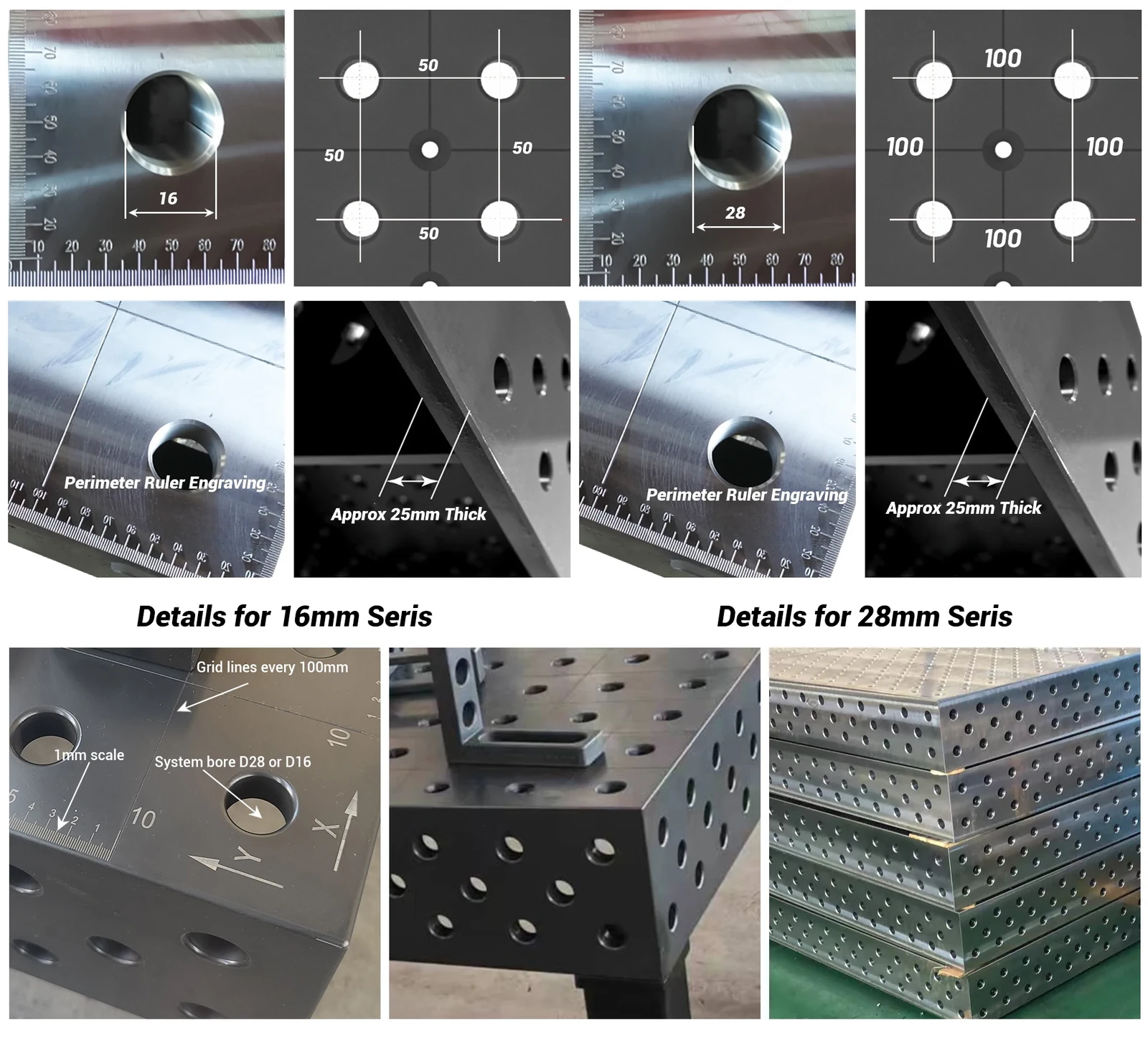
Hole size: D16, D22 or D28
The number after the D is the hole diameter in millimetres. It decides which tooling family fits and how much holding force it carries:
| System | Hole | Typical work |
|---|---|---|
| D16 | 16 mm | Small parts, light jigs, fine positioning |
| D22 | 22 mm | Mixed job sizes on one table |
| D28 | 28 mm | Large frames, thick plate, heavy structures |
Choose the system from your heaviest regular workpiece, not from the biggest number. Details in D16, D22 or D28: choosing a welding table hole system.
Hole spacing: 50 mm or 100 mm
Spacing is a separate decision from diameter. A 50 mm grid lets stops sit closer together for small parts; a 100 mm grid leaves more open surface for general fabrication. See Hole spacing on a welding table.
Plain bores or threaded holes
Holes can be plain bores for pins and locating elements, or threaded (metric M16 to M24, or imperial) for bolts and threaded accessories. The type must match the tooling you plan to buy. See Welding table hole types.
Do the holes weaken the table?
Not when the platform is designed for them. BECO platforms are welded steel bodies with internal reinforcing ribs, stress-relieved and then machined, so the grid is cut into a structure built to carry it. Spatter in the holes is the real risk to accuracy, which is why cleaning the grid is part of routine maintenance.
Specify the holes with the table
The hole system, spacing and type are fixed when the table is machined, so they belong on the quotation. Send your largest workpiece size and weight and we will recommend the grid. Request a quote or look at the D16, D22 and D28 tables.